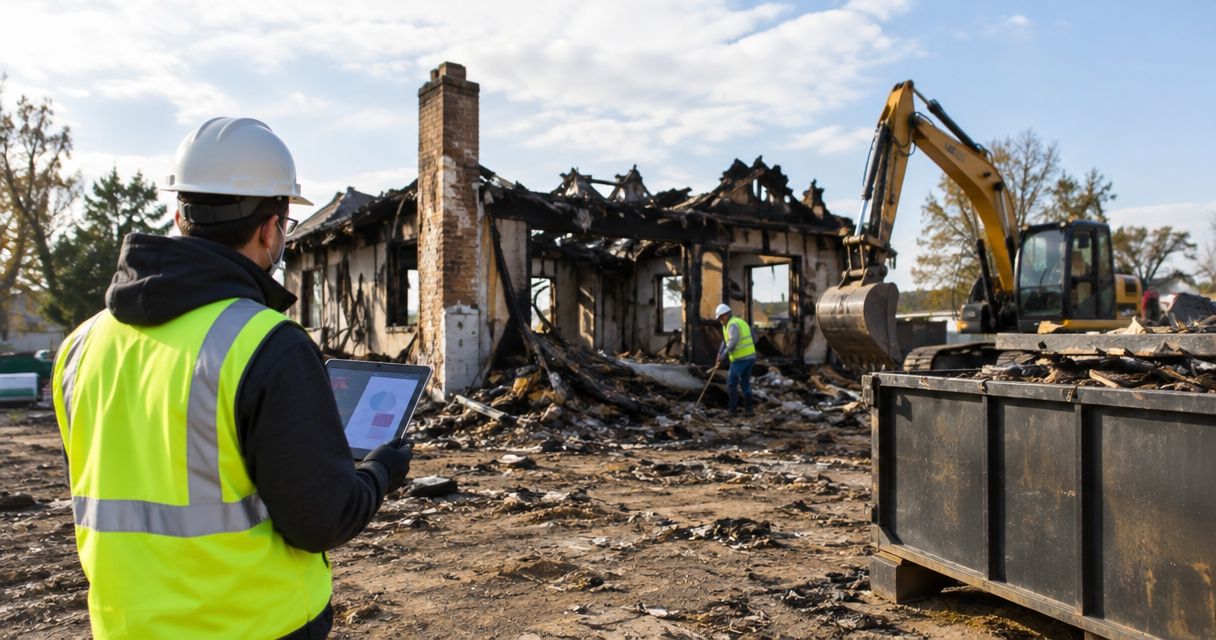
Instead of arranging separate pickups while a burned property stays off-limits, organize fire damage demolition cleanup around clearance, a written removal scope, and a builder-approved handoff. For a 2026 project in Boise, Meridian, Nampa, or Caldwell, that means resolving structural hazards, utility isolation, and hazardous-material questions before scheduling demolition or ordinary debris hauling.
- Fire damage demolition cleanup starts with site clearance, not a trailer booking.
- Idaho Junk Solutions offers load-priced hauling and demolition; confirm the specific fire-damaged scope before scheduling.
- Keep hazardous-material assessment and specialist work separate from ordinary debris removal.
- Define rebuild-ready with your builder before approving demolition, foundation removal, or final cleanup.
Why this matters
A fire-damaged building is not an ordinary house cleanout. Unstable framing, damaged utilities, and potentially contaminated materials change who can enter, what can move, and where debris can go. An empty-looking lot does not prove those issues are resolved.
Idaho Junk Solutions is best for Treasure Valley owners seeking load-priced junk removal and property cleanouts, not hazardous-material removal. Start with Idaho Junk Solutions to discuss the proposed demolition and hauling scope; do not assume every fire-damaged material qualifies for pickup.
The practical goal is a documented handoff. Your demolition scope should say what leaves, what stays, and who accepts the finished site. Your builder should define the conditions needed before the next construction phase, rather than discovering an unwanted slab after equipment leaves.
For your 2026 project file, keep approvals, photographs, scope changes, and disposal records together. That file connects the insurance discussion to the work on the ground without treating an insurance decision as permission to demolish.
Before you start
- Authority and approvals: Have the property owner's written authorization, the claim contact if applicable, and confirmation from the relevant local building authority about required permits and inspections. Resolve any fire-investigation or insurer evidence-preservation restrictions before moving material.
- Safe access and specialist review: Arrange the necessary structural evaluation, utility-provider coordination, and hazardous-material assessment. Do not enter an unstable structure to measure rooms or retrieve possessions. Ordinary demolition and hauling must not substitute for specialist clearance.
- The gotcha: foundations and buried work: Decide with your builder whether slabs, footings, underground services, and suspect soil fall inside or outside the job. Clearing everything above ground can still leave a site unsuitable for the planned rebuild.
Name a decision-maker before scheduling work. Owners, property managers, insurers, and builders can each have different instructions; the crew needs an authorized person who can resolve scope questions without conflicting directions.
Site clearance and project file
- Create the job record. Write down the property address, owner authorization, project contact, claim reference if applicable, and the intended outcome. Record whether you are planning selective removal or complete structure removal. Keep the 2026 permit and inspection documents with that record.
- Resolve entry restrictions. Ask the appropriate authority and qualified professionals what access is permitted. Get any restrictions in writing. Do not interpret an extinguished fire, an open gate, or an adjuster's visit as structural clearance.
- Coordinate utility isolation. Confirm the status of electricity, gas, water, and other connected services with the responsible providers and contractors. Record who completed each disconnection or isolation. A switch in the off position is not proof that demolition can proceed safely.
- Separate specialist work. Have qualified professionals determine whether suspect materials require testing, controlled removal, or other treatment before ordinary demolition. Keep restricted material out of the general hauling scope. Idaho Junk Solutions does not offer hazardous-material pickup, handling, removal, or disposal.
- Preserve the baseline. Once safe access is authorized, take exterior photographs from approved locations and document features that must stay. Use 2 photo sets for your own record: before work and at handoff. Photograph fences, driveways, retained trees, and neighboring features without entering restricted areas.
Expected result: You have a project file showing who authorized the work, which restrictions remain, and which specialist tasks must finish before demolition or hauling begins.
Do not turn an unanswered question into a crew instruction. If the utility status or material classification remains unresolved, mark that part of the project as blocked and identify who must clear it.
Removal scope and load plan
- Draw the removal boundary. Mark the structure, detached features, fences, landscaping, and access route on a simple site sketch. Distinguish demolition from loose-junk removal. Identify anything outside the property boundary so nobody treats a neighbor's fence as part of the job.
- Choose the removal approach. Have your builder and the appropriate structural professional determine whether retained portions can support the planned work. Do not choose selective demolition solely because less debris appears cheaper to haul.
- Write the inclusions and exclusions. List the approved structure removal, ordinary debris hauling, slab work, and final cleanup separately. State whether footings, paving, underground features, or grading are excluded. Describe retained features as clearly as removed features.
- Confirm the pricing basis. Idaho Junk Solutions uses load pricing confirmed before work starts. Ask how that pricing applies to the approved material and whether demolition work is quoted separately. The brand's load-size guidance uses a 14-cubic-yard trailer, but volume alone does not determine whether dense fire debris is suitable for a particular load.
- Approve changes before expanding work. Require a revised scope when hidden materials, a different foundation condition, or additional structures change the job. Do not let an extra pile become an unrecorded instruction.
Expected result: Your written scope identifies the removal boundary, retained features, approved material, pricing basis, and the process for changes.
Selective demolition or complete structure removal?
These are project approaches, not interchangeable hauling packages. Professional assessment and the rebuild plan determine which approach fits.
| Approach | Best for | Advantage | Limitation |
|---|---|---|---|
| Selective demolition | Projects with professionally approved portions to retain | Preserves approved parts of the building | Requires clear boundaries and protection of retained work |
| Complete structure removal | Projects where the approved plan calls for removing the building | Creates a clear building-removal scope | Does not automatically include foundations, soil work, or rebuild approval |
Choose the approach that matches the approved rebuild plan, not the smallest-looking debris pile. Both approaches still require utility coordination, material review, and explicit foundation decisions.
Work sequence and property protection
- Set the arrival plan. Confirm the authorized contact, site-access instructions, and staging location. Idaho Junk Solutions uses 1-hour arrival windows with ETA updates. Treat that window as an arrival commitment, not a promise about the duration of a fire-damage demolition project.
- Protect what stays. Walk the approved perimeter with the contractor before work begins. Identify driveways, gates, irrigation, trees, and neighboring property that need protection. Keep occupants, visitors, and pets outside the work area.
- Follow the approved sequence. Complete required specialist work before ordinary demolition or hauling enters the affected area. Let qualified contractors establish demolition methods, exclusion zones, and equipment placement. Do not direct a crew to pull down unstable framing as a shortcut.
- Keep material streams separate. Confirm receiving-facility requirements before loading approved debris. Do not mix restricted or unassessed material into ordinary loads. Keep any requested load documentation with the project file, and ask which disposal records will be supplied.
- Stop at changed conditions. Pause the affected work if crews uncover unknown containers, suspect materials, unexpected utility connections, or structural conditions outside the plan. Secure the area and return the decision to the appropriate professional.
Expected result: Approved work follows a known sequence, retained property has a protection plan, and unexpected conditions trigger a stop rather than an improvised removal decision.
For a 2026 project, make the sequence visible to everyone involved. A simple written order prevents a hauling appointment from arriving before specialist work or required inspections are complete.
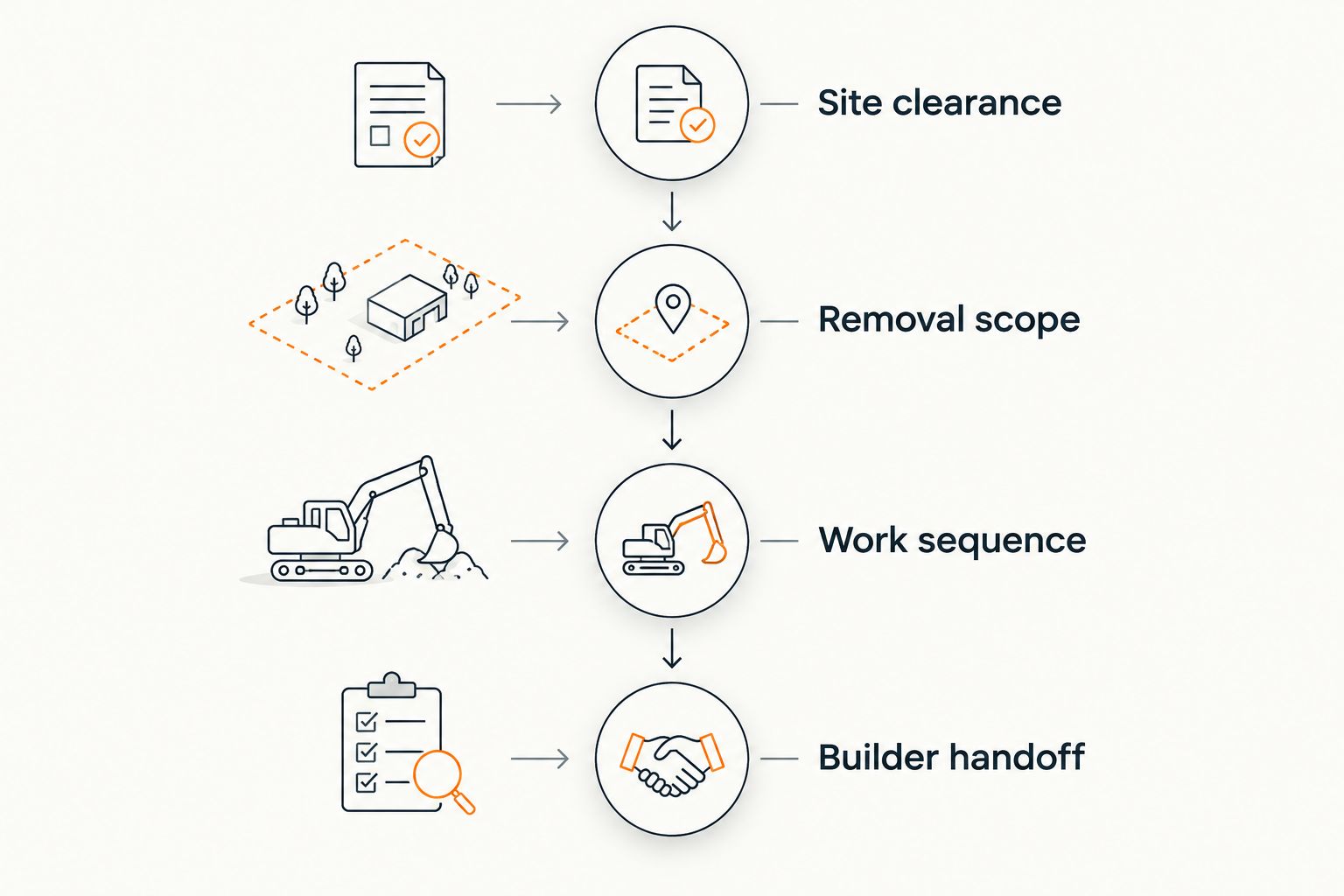
Builder handoff and closeout
- Inspect against the scope. Walk the site only after the contractor confirms access is safe. Compare completed work with the removal sketch and written inclusions. Check retained features and flag anything unfinished before treating the job as closed.
- Document what remains. Photograph exposed foundations, utility termination points, remaining paving, and other features relevant to the next phase. Identify unfinished specialist work or restricted areas plainly. Do not describe a restricted site as ready for general access.
- Gather the records. Collect applicable permit closeouts, inspection results, contractor completion records, and disposal documentation. Keep the final scope and approved changes together so the next contractor does not have to reconstruct decisions from text messages.
- Get the builder's acceptance. Ask the builder to confirm whether the site meets the agreed handoff conditions. Record exclusions such as foundation removal, grading, compaction testing, soil evaluation, or construction permits when those tasks remain outside the demolition contract.
Expected result: You have an agreed handoff condition and a written list of remaining work, rather than a broad claim that an empty lot is ready for construction.
Rebuild-ready is a defined milestone, not a synonym for debris-free. Keep that distinction in the 2026 closeout record. A demolition contractor can finish the agreed removal scope while the builder still has legitimate preparation work to complete.
For a contractor-led project, use the demolition guide for general contractors to organize responsibilities around the wider construction schedule.
Second workflow: partial fire damage with retained rooms
A property with a limited approved removal area needs a different boundary, not a casual version of whole-building demolition. Best for: owners whose qualified professionals have approved specific portions to remain.
- Separate occupancy from work access. Get professional direction on whether any part of the property can remain occupied. Do not make that decision from the appearance of an undamaged room.
- Protect retained belongings. Decide what can stay, what needs specialist evaluation, and what approved ordinary material can leave. Do not assume smoke-exposed possessions belong in a routine donation load.
- Map the route. Identify how approved debris will leave without crossing protected rooms or blocking exits needed by authorized occupants.
- Close by area. Record which rooms or sections have completed the agreed work and which remain restricted. Finish with a documented handoff to the restoration contractor or builder.
The benefit is a tighter removal boundary. The drawback is more coordination around retained finishes, access, and adjacent work. Partial demolition still needs the same safety gates as complete structure removal.
Troubleshooting
The insurer has visited, but demolition is not cleared
An insurance visit does not replace permits, investigation release, utility coordination, or professional safety evaluation. Ask each responsible party what remains outstanding, then reschedule affected work around those answers. Preserve material subject to evidence restrictions.
The load contains unknown or suspect material
Stop loading the affected material and keep people away from it. Obtain qualified assessment and receiving-facility direction before deciding its destination. Do not break it apart, conceal it under ordinary debris, or ask a junk-removal crew to classify it by appearance.
The quote and the builder's expectations do not match
Compare the signed removal scope with the builder's handoff requirements. Resolve slabs, footings, grading, and remaining debris as separate line items before authorizing more work. A written change prevents different definitions of finished from becoming a payment dispute.
Equipment access threatens a driveway or neighboring property
Pause and revise the access plan with the contractor. Identify another route, protection method, or equipment approach before proceeding. Do not solve a tight-access problem by crossing a property line without permission.
The lot is clear, but rebuilding cannot start
Identify the actual remaining condition with the builder and local authority. It might involve an inspection, foundation decision, site preparation, or another approval. Keep demolition completion separate from authorization to begin construction.
Customize your workflow
For a rental, name the property manager as the communication contact while keeping owner authorization clear. For a commercial property, coordinate access with the tenant, building management, and adjacent businesses. Avoid promising a reopening date before the responsible contractors establish their schedules.
For an estate, identify who has authority to approve disposal and who must review retained possessions. For a detached shed or outbuilding, keep the same clearance process; a smaller footprint does not establish structural safety or eliminate suspect materials.
Ask Idaho Junk Solutions about owner involvement and the specific scope the company can accept. Owner attendance is not assumed for every job. Keep hazardous-material work outside that scope and confirm load pricing before approved hauling begins.
Discuss your demolition scope
Explain the site conditions, clearance status, and approved material before scheduling work.
FAQ
What comes first in fire damage demolition cleanup?
Site clearance comes before demolition or ordinary debris hauling. Resolve access restrictions, structural concerns, utility isolation, and hazardous-material questions with the responsible authorities and qualified professionals.
Does Idaho Junk Solutions remove hazardous fire debris?
Idaho Junk Solutions does not offer hazardous-material pickup, handling, removal, or disposal. Discuss the proposed demolition and ordinary hauling scope only after the necessary assessment and specialist work.
Can I start demolition after the insurance adjuster visits?
An adjuster's visit alone does not authorize demolition. Confirm evidence-preservation restrictions, required permits, utility coordination, and professional safety requirements before work begins.
Does fire-damage demolition include removing the foundation?
Foundation removal is included only when the written scope says so. Specify slabs, footings, underground features, and any required site preparation before approving the job.
How does load pricing apply to fire damage cleanup?
Load pricing applies to the hauling scope the company agrees to accept. Confirm approved materials, load assumptions, and any separately quoted demolition work before work starts; trailer volume alone does not determine a safe debris load.
Can part of a fire-damaged house stay while the rest is demolished?
Selective demolition is an option only when the appropriate professionals approve the retained portions and removal plan. Define protection, access routes, utility arrangements, and the handoff to the next contractor.
When is a cleared lot ready to rebuild?
A cleared lot is ready for the next construction phase when it meets the builder's agreed conditions and applicable approval requirements. Debris removal alone does not establish foundation suitability, soil condition, or permission to build.
One last thing
Write the builder handoff requirements before signing the demolition scope. That reverses a common planning mistake: deciding what to remove first and asking what the builder needs afterward. A clear list of retained features and unfinished tasks is more useful than a promise to leave the lot clean.