
Instead of clearing desks piecemeal while your lease deadline gets closer, plan office downsizing junk removal around one approved inventory, a confirmed hauling scope, and a documented suite handoff. This 2026 workflow takes you from occupied office to empty suite without mixing company assets, confidential records, and approved junk.
- Idaho Junk Solutions suits office downsizing junk removal when businesses need load-priced commercial cleanout hauling.
- Approve furniture removal separately from records destruction, electronics disposition, and demolition.
- Confirm the load scope before work starts; keep retained assets outside the removal area.
- Finish with a room-by-room inspection against the landlord’s written handback requirements.
Why this matters
Idaho Junk Solutions is best for Treasure Valley businesses that need load-priced office cleanout hauling. The locally owned company serves homeowners, businesses, and property managers; your job is to define exactly what leaves and what stays.
For businesses in Boise, Meridian, Nampa, and Caldwell, Idaho Junk Solutions offers junk removal and property cleanout hauling. Clear load pricing is confirmed before work starts, with one-hour arrival windows and ETA updates. Owner involvement is part of the approach, but the owner does not attend every job.
An empty office is not automatically a finished lease handback. Furniture removal, cleaning, repairs, and landlord acceptance are separate tasks. For a 2026 office closure, put those tasks on the same schedule without treating them as the same service.
The main trade-off: load-priced hauling handles approved junk, but it does not replace asset approval, secure records disposal, or an agreed restoration scope. Resolve those decisions before the loading starts.
Before you start
- Get written authority. Name one company decision-maker and one building contact. Obtain the lease handback requirements, access instructions, loading-area rules, and any insurance documentation the building requests.
- Prepare the materials. Bring a room list, current photos, removable labels, an approved asset list, and a shared checklist. Record furniture dimensions where doorways, elevators, or tight turns affect the route.
- Check the hidden blocker: ownership and connections. Leased copiers, landlord-owned fixtures, network equipment, and attached partitions are not ordinary junk. Confirm ownership and arrange any required disconnection before including them in the hauling scope.
Do not use a cleanout crew as the default answer for an unknown container, damaged battery, chemical, or suspected hazardous material. Keep those items out of the hauling scope and obtain direction from an appropriate specialist. Idaho Junk Solutions does not offer hazardous-material pickup, handling, removal, or disposal.
Inventory and disposition plan
- Walk every room. Include reception, offices, conference rooms, storage areas, break rooms, and any assigned exterior storage. Photograph the contents before anyone starts moving furniture.
- Create one inventory. Give each room a name that matches its door label or floor plan. For each group of items, record quantity, destination, approval status, and anything that needs disconnecting.
- Assign a disposition. Use four labels: Keep, Return, Donate, and Remove. Add a separate Hold status for anything awaiting a decision; do not let uncertainty become permission to haul.
- Approve the removal list. Have the authorized company contact sign off on the list and photos. Send changes through that same person rather than accepting conflicting instructions from different employees.
Expected result: every visible item has an approved destination or a clear hold status. The hauling list contains only items authorized to leave.
The options below serve different purposes. A donation plan is not a confirmed donation pickup, and an item marked for return still needs a return arrangement.
| Disposition | Best for | Main advantage | Main limitation |
|---|---|---|---|
| Keep | Furniture and equipment needed in the smaller office | Preserves assets already selected for reuse | Requires a destination and a moving plan |
| Return | Leased equipment or property belonging to someone else | Keeps another party’s assets out of the junk load | Requires owner instructions and coordination |
| Donate | Usable items accepted by a recipient | Keeps accepted furniture in use | Acceptance and transportation must be confirmed |
| Remove | Approved unwanted items within the hauling scope | Clears the agreed junk from the suite | Does not settle records, ownership, or repair obligations |
Keep the inventory practical. A row reading “conference room furniture” leaves room for mistakes; a row naming the table, chairs, and cabinet makes the decision visible. Identify retained items individually when similar furniture is leaving.
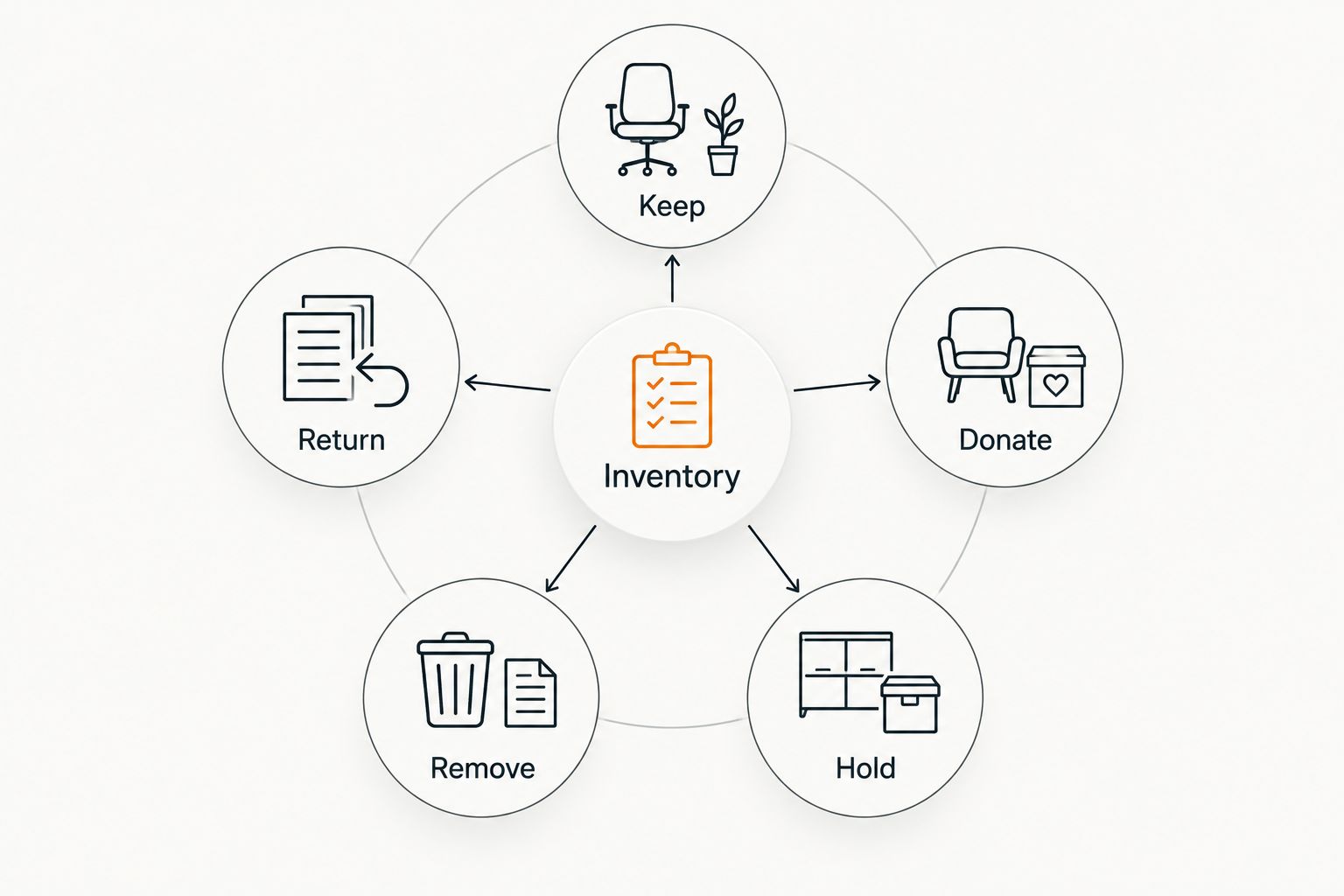
Hauling scope and building access
- Send the approved scope. Share room photos, the removal list, large-item dimensions, and the suite location. Flag stairs, elevators, loading restrictions, long carrying routes, and furniture that needs assessment before removal.
- Describe volume honestly. List the furniture and loose contents rather than guessing from floor area alone. An office full of assembled desks presents a different load than the same room holding flattened boxes.
- Confirm the work boundary. Separate loose-item hauling from attached fixtures, dismantling, demolition, cleaning, and repairs. Ask which tasks are included and obtain agreement before adding them to the job.
- Coordinate arrival and access. Align the one-hour arrival window with building access, elevator reservations, parking instructions, and the person authorized to approve the scope. Keep the contact reachable for ETA updates.
Expected result: the company contact, building contact, and hauling crew are working from the same removal list and access plan.
Idaho Junk Solutions prices hauling by the load. Its load-size guidance uses a 14-yard trailer, but a trailer measurement is not a furniture-count guarantee. Show the actual contents and confirm the load pricing before work starts.
Put the agreed scope in your 2026 cleanout checklist. Include what is excluded as clearly as what is included: retained furniture, leased equipment, confidential records, and any work assigned to another contractor.
Do not book access on an assumption. Ask the building contact whether an elevator reservation, loading-area booking, protective materials, or access escort is required. A clear hallway is useful; permission to use the freight route is essential.
If furniture remains usable, settle its destination before the hauling visit. Do not promise donations to employees or recipients without assigning responsibility for collection. Otherwise, the crew arrives to a removal list that is still changing.
Loading authorization and property protection
- Secure retained assets. Move smaller keep items into a closed, clearly marked room where practical. Label larger items in place, and show the crew anything that must remain.
- Inspect the carrying route. Walk from the removal area to the loading point. Record existing damage, identify tight corners, and agree on any protection needed for floors, doors, and elevator surfaces.
- Review the load before work starts. Compare the visible contents with the approved list. Confirm the load pricing and scope before authorizing the crew to begin; resolve additions rather than assuming they are included.
- Release work by area. Keep the authorized contact available while the crew works. Check each cleared room before releasing the next area if similar items are split between keep and remove.
Expected result: approved junk leaves through an agreed route while retained property stays clearly separated.
Do not ask employees to disconnect building wiring, plumbing, or unfamiliar equipment just to keep the cleanout moving. Arrange the appropriate qualified contractor when disconnection is needed. A loose desk and a wired workstation partition do not have the same preparation requirements.
Confidential material needs its own boundary. Empty desk drawers, cabinets, and storage boxes before approving furniture for removal. Keep records and data-bearing equipment under company control until your organization’s authorized disposal process takes over.
For partially occupied offices, separate staff movement from the carrying route. Tell employees which areas are closed for loading, keep exits unobstructed, and avoid placing a temporary junk pile in a shared corridor.
Empty-suite verification and handoff
- Check the removal list. Walk each room with the approved inventory. Confirm that the listed junk is gone and that nothing marked keep, return, or hold left by mistake.
- Photograph the cleared space. Capture room overviews and the loading route after removal. Photograph any remaining items separately, with the reason they stayed recorded in the checklist.
- List unfinished work. Assign cleaning, repairs, fixture work, and any remaining contractor tasks to a named person. Do not mark those tasks complete just because the furniture is gone.
- Request the building walkthrough. Compare the suite with the landlord’s written requirements. Record remaining actions, then handle key and access-device return through the agreed handoff process.
Expected result: you have evidence of the hauling work, a clear list of anything outstanding, and a documented path to building acceptance.
A photo set proves what the suite looked like; it does not replace the landlord’s approval. Keep both the photos and the written handoff correspondence with the inventory.
For a 2026 lease surrender, check the actual lease and building instructions rather than copying another tenant’s checklist. “Empty” might describe furniture removal while leaving separate obligations for alterations, cleaning, or repairs. Obtain clarification before treating the job as finished.
Rolling downsizing while the office stays open
A phased cleanout works best when staff move between rooms before the old office closes. The advantage is a smaller disruption to occupied areas; the drawback is more coordination and repeated access planning.
Use the same inventory, but add an Approved for release field and a named approver for each area. Do not release a desk simply because its user moved; confirm that its drawers, cables, and assigned equipment have been checked.
- Group work by area. Clear one approved department or room group before moving the removal boundary.
- Keep a fixed hold area. Store undecided items away from anything already released for hauling.
- Reconfirm each scope. Photograph additions and confirm the load pricing before each agreed hauling stage begins.
- Close each stage. Update the inventory immediately so yesterday’s removal list does not become tomorrow’s instruction.
For a phased 2026 move, version the list by approval date and area. A filename alone is not enough: the person authorizing loading should be able to identify the current approved contents without opening several competing documents.
Troubleshooting
The load is larger than the approved scope
Stop and identify the additions. Photograph them, update the removal list, and confirm revised load pricing before authorizing extra work. Do not let a late pile of boxes quietly change the agreement.
The freight elevator or loading area is unavailable
Contact the building representative before unloading equipment or blocking a shared entrance. Confirm an approved alternative or revise the schedule. Tell the hauling crew about the restriction immediately rather than leaving the discovery until arrival.
Donation plans fall through
Keep the affected furniture separate and get a new decision from the authorized company contact. If removal becomes the chosen option, add the items to the hauling scope and confirm the load pricing before work starts.
The suite contains records or unknown materials
Pause work around the affected items. Route confidential records through your authorized records process, and keep unknown or suspected hazardous materials outside the hauling scope. Do not ask the crew to identify, open, or dispose of them.
The landlord will not accept the cleared suite
Ask for the outstanding requirements in writing. Match each item to the lease or agreed instructions, assign the appropriate contractor, and arrange another walkthrough. More hauling will not resolve a repair or restoration requirement.
Customize your workflow
Expand the inventory before expanding the job. For a larger commercial property cleanout, add storage rooms, exterior items, and shared spaces only after confirming who owns the contents and who can authorize removal.
If your office project includes attached fixtures or a broader strip-out, use the demolition for retail store remodels guide to frame the separate demolition discussion. Do not treat demolition as an automatic extension of furniture hauling.
Send Idaho Junk Solutions the approved item list, room photos, access details, and your target handback date. Request confirmation of the scope and arrival arrangements; do not assume a date is booked until it is confirmed.
Plan your office cleanout
Share the approved removal list, room photos, access details, and target handback date.
FAQ
What should I do first before office downsizing junk removal?
Approve an inventory showing what stays, what returns to its owner, what has a confirmed donation destination, and what leaves as junk. Put undecided items on hold and name one person to authorize removal.
How does Idaho Junk Solutions price an office cleanout?
Idaho Junk Solutions prices hauling by the load and confirms clear load pricing before work starts. Share photos, the item list, and access details so the agreed scope reflects the actual job.
Can an office cleanout happen while employees are still working?
A phased cleanout can separate approved removal areas from occupied work areas. Use a current release list, control the carrying route, and confirm each stage’s scope before loading begins.
Should I donate office furniture or have it hauled away?
Donate furniture when a recipient has accepted it and transportation is arranged; use hauling for approved unwanted items within the agreed scope. Keep unconfirmed donations separate until the authorized contact decides their destination.
Does office junk removal include confidential document destruction?
Do not treat ordinary office junk removal as confidential document destruction. Keep records and data-bearing equipment under company control and use your organization’s authorized disposal process.
Can the cleanout crew remove wired partitions or hazardous materials?
Do not include wired partitions as ordinary loose-item hauling, and exclude hazardous materials from the removal scope. Arrange qualified disconnection where needed; Idaho Junk Solutions does not offer hazardous-material pickup, handling, removal, or disposal.
Does removing all the furniture satisfy my office lease?
Furniture removal alone does not establish that your lease handback requirements are complete. Check the written requirements for cleaning, repairs, alterations, and landlord acceptance before returning keys.
One last thing
Open every drawer before approving its cabinet for removal. A room can look empty while a pedestal drawer still holds keys, personnel files, or equipment assigned to another employee. Put the drawer check on the release list, not on someone’s memory.