
General contractors’ demolition services are planned removal and debris hauling with the aim of handing the next trade a work-ready site. This guide explains how to scope demolition services for general contractors in 2026, coordinate utilities, confirm load pricing, and keep removal work separate from anything that needs specialist handling.
- Demolition services for general contractors need written removal limits, utility clearance, debris planning, and a defined handoff.
- Idaho Junk Solutions suits Treasure Valley contractors seeking demolition and load-priced hauling.
- Confirm load pricing before work starts; define demolition scope separately from the debris estimate.
- A one-hour arrival window helps coordinate access, but it is not a project completion promise.
Why demolition matters for general contractors
Demolition sits between the existing property and the work you are responsible for delivering. Your subcontractor needs to know what comes out. Your next trade needs to know what remains, and your customer needs the property protected throughout the job.
The complication is not just removing material. It is coordinating access, utility isolation, retained finishes, debris staging, and the handoff without letting an unclear instruction become an unwanted removal.
Idaho Junk Solutions is best suited to Treasure Valley contractors seeking demolition and load-priced debris hauling. The locally owned company serves homeowners, businesses, and property managers, giving contractors a local option for removal work connected to a larger property project. Start with Idaho Junk Solutions to discuss the actual scope rather than assume every demolition task is included.
For contractors working in Boise, Meridian, Nampa, and Caldwell, the practical question is straightforward: who removes the agreed material, who clears it away, and what condition must the site be in afterward? Your 2026 work order should answer those questions before demolition begins.
How to plan demolition for a contractor-led job
1. Write the removal limits before requesting a quote
Start with a walkthrough and a written list. You do not need special software to make a useful scope; marked photos, a sketch, and a room-by-room description give a subcontractor something concrete to assess.
Separate removal from retention. A note saying to clear a room is not enough when cabinets, plumbing fixtures, trim, or flooring have different instructions. Identify where demolition stops, including any adjacent area that must remain untouched.
For a shed or other structure, describe the structure and its surroundings without assuming demolition includes the foundation, buried connections, or nearby landscaping. Ask for those boundaries to be addressed explicitly.
Use 3 photo angles as a practical starting point: the item or area being removed, the route to it, and the proposed loading position. This is a documentation recommendation, not a substitute for an on-site assessment.
Close the scope with concrete instructions:
- Identify each room, structure, or removal area.
- Mark items that must stay.
- Describe the stopping point at adjoining surfaces.
- Photograph the access route and loading position.
- List hidden conditions that need assessment before work.
2. Confirm utility isolation and safety responsibilities
Before selecting a removal method, establish what is connected to the work area. Electrical wiring, water lines, gas service, and other connections need a clear responsibility chain. Do not treat an apparently unused fixture as proof that a connection is inactive.
Write down who arranges isolation, who confirms it, and what evidence the demolition crew receives. Assign those tasks to the appropriate qualified professional or utility provider. A demolition arrival should not become the moment everyone discovers that disconnection was assumed rather than completed.
Check project-specific permit and inspection requirements with the relevant local authority. Requirements depend on the actual work; a general guide cannot establish permission for your individual property.
Stop and arrange specialist assessment when suspect hazardous material is present. Idaho Junk Solutions does not offer hazardous-material pickup, removal, handling, or disposal. Keep that work outside its demolition and hauling scope.
Make the safety handoff explicit:
- Identify utilities connected to the removal area.
- Assign disconnection and confirmation responsibilities.
- Check applicable permits and inspections.
- Flag suspect materials before disturbing them.
- Record conditions that require work to stop.
3. Match the subcontractor to the actual job
First decide what you need: labor for removal, debris hauling, a property cleanout, or a combination. These are related tasks, but they are not interchangeable. A hauler arriving for loose debris has a different assignment from a subcontractor asked to dismantle a structure.
For a straightforward starting point, send the same written scope to each provider you consider. Ask each provider to explain what is included, what is excluded, and what must happen before arrival. Compare those answers before comparing the overall proposal.
Idaho Junk Solutions offers demolition, load-priced hauling, and full property cleanouts. That combination fits a contractor discussing both removal and clearance, but the service description does not establish suitability for every structure or every demolition method. Confirm the individual job before scheduling it.
Owner involvement is another useful question, not an assumption. Ask who will assess the scope and who will coordinate the work; do not build your plan around the owner attending every job.
Use these selection checks:
- Confirm the proposed removal task is accepted.
- Ask whether hauling is included in the scope.
- Identify exclusions and prerequisite work.
- Establish the person responsible for coordination.
- Agree on the condition expected at handoff.
4. Estimate debris and confirm load pricing
Walk the site and list what will leave before trying to estimate the load. Separate loose contents from material that will be dismantled. A room containing furniture and a shed being taken apart present different estimating problems, even when both need hauling.
Idaho Junk Solutions uses load pricing for hauling, with pricing confirmed before work starts. Its load-size guidance refers to a 14-cubic-yard trailer. Treat that as a reference for discussing volume, not a promise that your demolition debris will fit in a particular number of loads.
Material shape, weight, and the agreed loading arrangement matter. Ask the provider to assess the actual debris instead of converting floor area directly into trailer volume. Also establish how additional material discovered during the job will be handled.
For your 2026 estimate, keep demolition labor and hauling scope clear even when they appear in the same proposal. Load pricing explains the hauling basis; it does not, by itself, define every demolition task.
Confirm these points before approval:
- List the materials expected to leave.
- Separate contents removal from dismantling work.
- Ask how the load estimate was established.
- Confirm pricing before work starts.
- Require approval before adding removal areas or material.
5. Plan access, protection, and debris staging
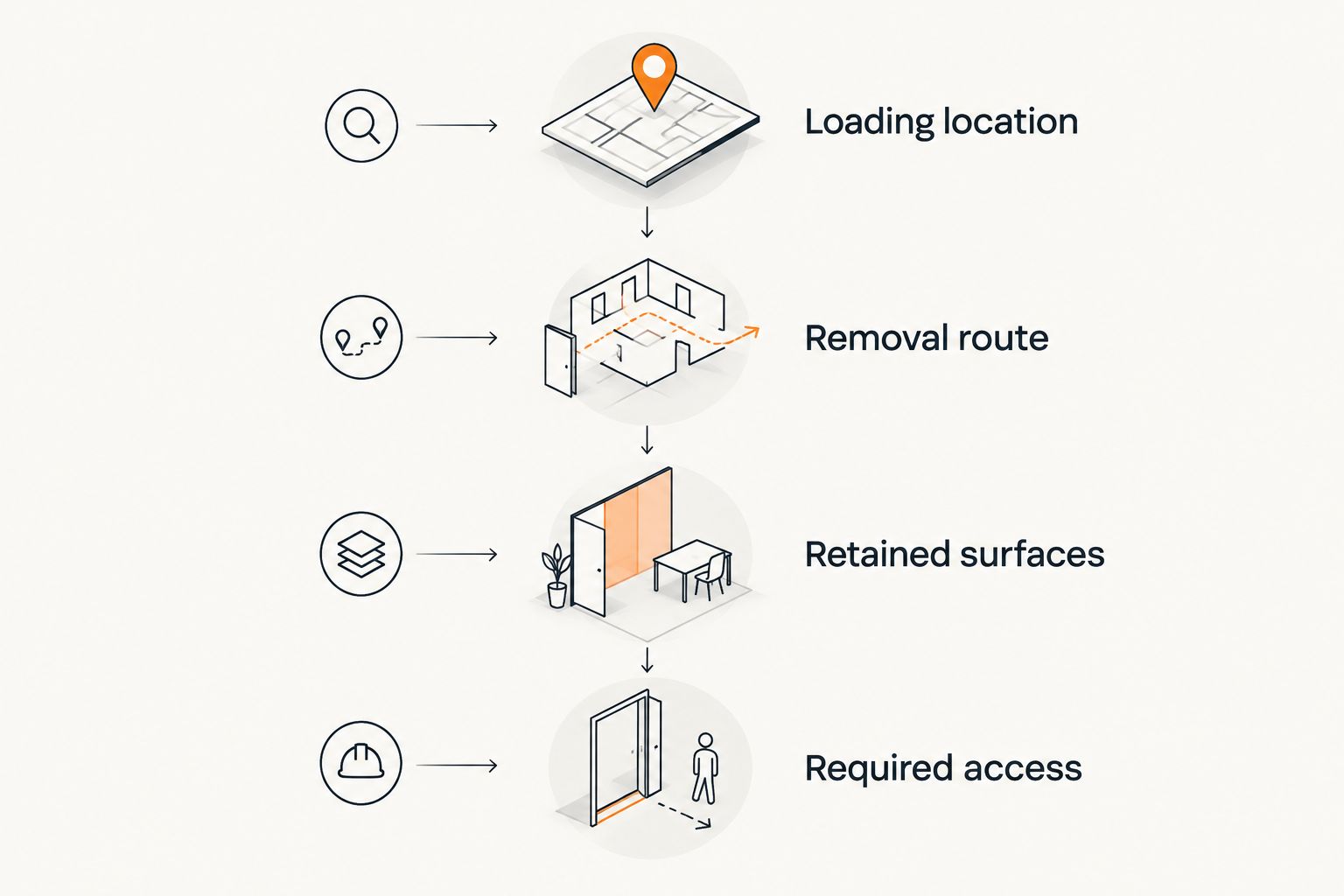
Start with the route, not just the pile. Walk from the work area to the loading location and identify doors, steps, narrow turns, shared access, and surfaces you need protected. Include anything that changes how material can leave the property.
For an occupied home or operating business, define the boundary between the work zone and people who are not involved in demolition. Tell the subcontractor what must remain accessible and which areas are off limits. Coordinate those requirements with the property's responsible contact.
Choose a debris staging location deliberately. Material left in the wrong place can obstruct the next trade, block an entrance, or make the removal route harder to use. Agree where debris belongs and who keeps the route clear.
Protecting the property also means documenting its starting condition. Photographs of retained finishes and adjacent surfaces make the instructions more useful and the final walkthrough more specific.
Finish the access plan with these tactics:
- Photograph retained surfaces beside the work area.
- Agree on a loading location.
- Identify protection needed along the removal route.
- Keep exits and required access clear.
- Assign responsibility for opening and securing the property.
6. Coordinate arrival without promising completion
Build the schedule around verified prerequisites. Utility confirmation, property access, approved scope, and loading arrangements should be settled before the crew is expected. Sending a subcontractor into an unresolved site does not make the project ready.
Idaho Junk Solutions provides one-hour arrival windows with ETA updates. Use that window to coordinate the person opening the property and any access restrictions. It describes arrival, not the duration of the demolition job or a guarantee that another trade can start immediately afterward.
Keep the next trade informed about the condition they should expect, then schedule their access around confirmed completion rather than the demolition crew's arrival time. A progress update and a handoff confirmation serve different purposes.
Your 2026 schedule should name the contact who can approve a scope change. If unexpected conditions appear, the crew needs a decision-maker, not a chain of unanswered messages.
Set the coordination rules:
- Confirm prerequisite work before arrival.
- Share the site contact and access instructions.
- Use ETA updates to coordinate entry.
- Name the person authorized to approve changes.
- Confirm completion before releasing the next trade.
7. Inspect the handoff against the written scope
Use the original removal list for the final walkthrough. Check what was removed, what remains, and whether the loading route and staging area meet the agreed condition. Do not replace those checks with a general impression that the room looks better.
A work-ready handoff is specific to the next task. It does not automatically mean finish-ready surfaces, structural repair, or every trace of dust removed. Put the required condition in the scope so the demolition subcontractor and following trade use the same definition.
Record anything that needs follow-up before the next trade covers the area. If demolition exposed an unexpected condition, preserve the information and arrange the appropriate assessment rather than treating concealment as completion.
For a 2026 property project, the final record should connect the approved scope, any authorized changes, and the condition delivered. That gives you a useful job record rather than an unstructured collection of messages.
Close the job with these checks:
- Compare completed removal against the scope.
- Inspect retained areas and the removal route.
- Confirm agreed debris has left the site.
- Record unresolved conditions and responsible parties.
- Notify the next trade that the handoff is complete.
Compare demolition and hauling options
Choose the option that covers the work, not just the removal pile. Each approach has a useful role and a limitation. Confirm who performs demolition, who loads debris, and who coordinates disposal before selecting one.
| Option | Best for | Main advantage | Key limitation |
|---|---|---|---|
| Contractor-managed crew | Contractors with suitable labor and supervision | Direct control of work sequencing | You retain responsibility for labor, loading, hauling, and coordination |
| Demolition subcontractor | Defined removal requiring a dedicated subcontract scope | A separate work package with clear boundaries | Hauling and final cleanup must be confirmed rather than assumed |
| Dumpster rental | Jobs where your crew will remove and load material | Debris collection stays on site during work | A container does not supply demolition labor or loading labor |
| Idaho Junk Solutions demolition and hauling | Treasure Valley contractors seeking removal and load-priced hauling | Demolition, cleanouts, and hauling can be discussed together | The actual demolition task and exclusions need confirmation; hazardous materials are excluded |
For a larger cleanout tied to renovation, combining accepted removal work with hauling reduces the number of separate assignments you need to define. For work outside a provider's confirmed scope, use the appropriate specialist instead. Neither choice removes your responsibility to establish utility clearance and site requirements.
Common mistakes general contractors make
Treating a hauling quote as a demolition scope
A load estimate describes material leaving the property. It does not establish permission to remove every fixture, surface, or structure. Approve the demolition boundaries and the hauling basis separately.
Leaving the stopping point to the crew
Instructions such as removing everything create trouble when some surfaces must remain. Mark the boundary at adjoining finishes, foundations, and connected components before work starts. Give the crew an instruction they can follow without guessing your renovation plan.
Scheduling the next trade from the arrival window
An arrival window tells you when access is needed. It does not establish when the space will be released. Confirm completion and inspect the handoff before directing another trade into the area.
Assuming a tough-job service includes hazardous materials
Difficult access, large cleanouts, and demanding removal work do not mean hazardous-material service. Keep suspect materials out of the ordinary demolition and hauling plan. Arrange qualified assessment and any required specialist work separately.
Accepting changes without recording them
An extra removal request changes the job, even when it sounds small during a walkthrough. Record the added scope and get approval before work proceeds. That protects retained property and keeps the final handoff tied to what was actually authorized.
FAQ
What are demolition services for general contractors?
Demolition services for general contractors are agreed removal tasks performed as part of a contractor-led project. The scope should identify what comes out, what stays, who handles utilities, and whether debris hauling is included.
Who should arrange utility disconnections before demolition?
The general contractor should assign utility disconnection and confirmation to the appropriate qualified professional or utility provider. Record the responsibility before demolition is scheduled rather than assuming the removal crew handles it.
Is demolition with hauling better than renting a dumpster?
Demolition with hauling fits jobs where you need both removal work and debris clearance, while a dumpster fits jobs where your crew performs demolition and loading. Confirm the accepted scope and site requirements before choosing either option.
How does load pricing work for demolition debris?
Load pricing bases hauling on the agreed load rather than establishing the entire demolition scope. Confirm the load assessment, removal work, and approval process for added material before work starts.
Can Idaho Junk Solutions remove hazardous materials during demolition?
No. Idaho Junk Solutions does not offer hazardous-material pickup, removal, handling, or disposal. Suspect materials require separate specialist assessment and any necessary specialist work.
Does a one-hour arrival window mean demolition takes one hour?
No. A one-hour arrival window describes when the crew is expected, not how long the demolition will take. Coordinate the following trade around confirmed completion and the agreed handoff.
What should a contractor include in a demolition request?
Include removal boundaries, retained items, site photos, utility status, access instructions, and the required handoff condition. Identify the person authorized to approve changes so unexpected conditions receive a clear decision.
One last thing
Write the handoff description before you write the arrival date. A cleared room, a dismantled shed, and a site ready for the next trade are different outcomes. Name the outcome, confirm who delivers each part, and inspect against that agreement. The schedule becomes useful once everyone knows what completion actually means.