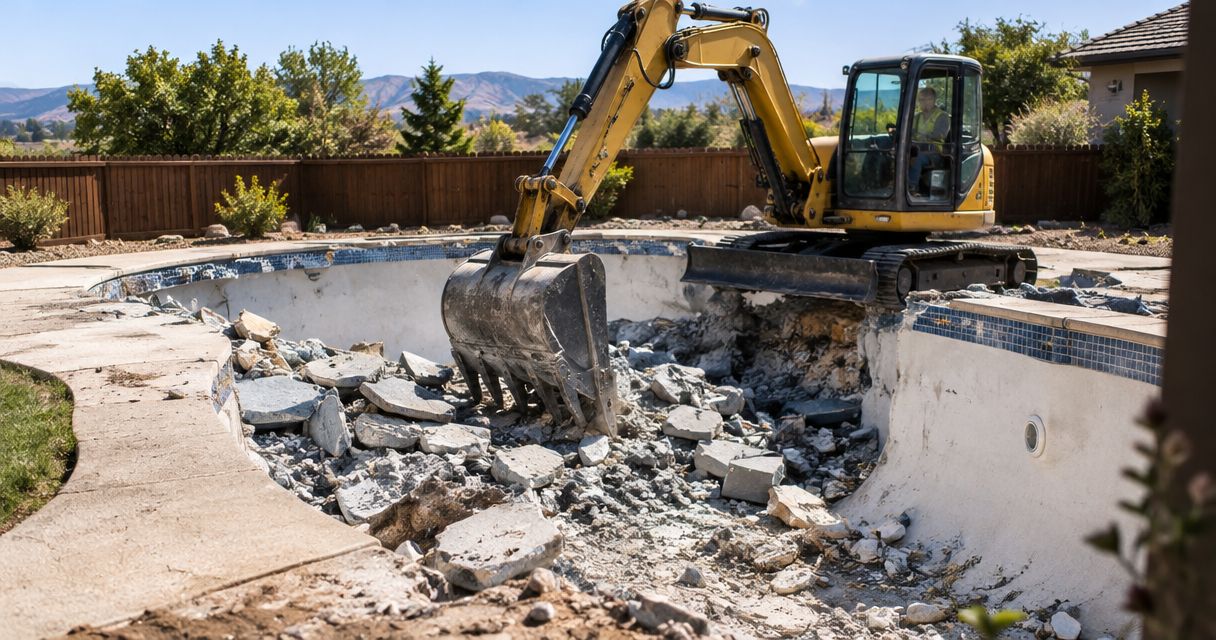
Pool demolition cost in Boise depends on the pool’s construction, what must be removed, and the condition you want the yard left in. For a 2026 project, get a written, site-specific quote rather than treating a hauling estimate as the complete demolition bill. The quote needs to address utility disconnection, debris removal, any required approvals, and whether backfilling and yard restoration are included.
- Pool demolition cost Boise quotes need a defined removal scope, debris plan, and finished-yard condition.
- Compare above-ground removal, partial in-ground removal, and full removal by scope—not just the total.
- Idaho Junk Solutions offers load-priced hauling and demolition; confirm your pool’s scope before booking.
- Keep utility disconnection, drainage, backfill, and restoration responsibilities clear before work starts.
Why this matters
A pool coming out of the ground is not the same job as a pile of junk leaving the driveway. Breaking the structure, loading the debris, and making the remaining site suitable for its intended use are separate parts of the work.
Compare the finished result, not just the demolition line. A quote that ends with an open excavation is not equivalent to a quote that includes an agreed backfill and grading plan. The job-site walk-through to debris-free handoff workflow provides a useful framework for defining where a demolition job starts and stops.
How much does it cost to tear down a swimming pool in Boise in 2026?
Your pool demolition price needs to come from an assessment of the actual structure and site. Specify the pool type, removal method, surrounding demolition, hauling, and final ground condition before asking contractors to put a total on the work.
Use this breakdown to check what a quote covers. These are scope items to resolve, not charges that automatically apply to every pool.
| Scope item | What the written quote should explain | What to watch for |
|---|---|---|
| Pool structure | Which walls, floor, liner, frame, or shell sections are removed | A vague promise to “remove the pool” |
| Surrounding structures | Whether decking, coping, fencing, or equipment pads are included | Assuming nearby concrete is part of the job |
| Utilities and water | Who arranges disconnection and an approved drainage plan | Demolition scheduled before these responsibilities are settled |
| Debris handling | What leaves the property and how hauling is priced | Treating all debris as ordinary household junk |
| Backfill and grading | Material, placement, compaction, and agreed finished condition | Assuming a filled hole is ready for any future use |
| Approvals and closeout | Who confirms requirements with the authority having jurisdiction | Relying on an unsupported “no permit needed” statement |
Ask each contractor to quote the same scope. If one proposal removes surrounding decking and another leaves it, the totals do not describe the same job.
Above-ground pool removal: define what stays
Above-ground pool removal centers on dismantling the pool and taking away the agreed components. Your scope should identify the frame, liner, ladder, pump equipment, and any attached structures separately.
Best for: homeowners removing an above-ground pool while keeping selected surrounding features. The advantage is a clearly bounded dismantling job; the limitation is that the ground beneath the pool and any attached deck still need their own plan.
Tell the contractor whether you want the deck retained. A deck built around a pool opening needs assessment before you treat it as a usable stand-alone structure. Do not assume taking away the pool also resolves the deck’s condition.
For your 2026 quote, photograph the entire setup rather than just the pool wall. Include the equipment area, connections, deck attachments, and route from the backyard to the loading area. Those details help establish the work you are actually requesting.
Partial in-ground removal: verify the remaining structure
Partial in-ground removal leaves some portion of the pool structure below ground. Before selecting this approach, confirm whether it is acceptable for your property and intended future use with the relevant local authority and qualified professionals.
Best for: owners whose proposed yard use and approved removal plan allow retained underground structure. The trade-off is straightforward: less structure is removed, but buried material remains part of the property’s history.
Require a written description of what is broken out, what remains, and how the excavation will be filled. “Fill in the pool” does not explain those decisions.
Keep the approved scope, inspection records where required, and completion documentation. If you later sell or change the use of the area, a clear record is more useful than a verbal assurance that the pool was handled correctly.
Full in-ground removal: define the excavation and finish
Full in-ground removal calls for removing the pool structure identified in the demolition plan rather than intentionally retaining part of it underground. The quote should distinguish the pool shell from adjacent patios, equipment pads, and other structures.
Best for: owners who want the pool structure removed rather than left beneath the yard. The advantage is a removal scope without intentionally retained pool sections; the limitation is the additional excavation, material handling, and restoration work that must be addressed.
Full removal does not automatically make the site suitable for a building. If you plan a garage, addition, or other structure, establish the design and ground-preparation requirements with the appropriate professionals before demolition.
| Removal approach | Best for | Main advantage | Main limitation |
|---|---|---|---|
| Above-ground dismantling | Removing a freestanding pool setup | Scope can focus on identifiable components | Decks, connections, and ground repair remain separate decisions |
| Partial in-ground removal | Approved plans allowing retained structure | Removes only the structure specified in the plan | Buried pool material remains |
| Full in-ground removal | Owners seeking removal of the pool structure | Avoids intentionally retaining pool sections | Excavation and site restoration require a detailed scope |
Why pool demolition quotes vary
Pool projects differ in more than their visible footprint. For a useful 2026 comparison, ask contractors to address these factors directly:
- Pool construction: Identify whether the work involves a dismantled frame, a liner system, a fiberglass shell, concrete, or a combination. The demolition method must match the structure.
- Removal boundary: Mark whether steps, coping, surrounding decking, equipment pads, fencing, and landscaping are included or protected.
- Loading route: Document gates, turns, overhead clearance, slopes, and surfaces that need protection. Ask how the contractor plans to move equipment and debris.
- Debris scope: Establish which materials will be hauled away, whether any material remains under an approved plan, and how each hauling component is quoted.
- Finished condition: Separate demolition from backfill, compaction, grading, topsoil, irrigation repairs, and landscaping. Specify which of those tasks you are buying.
- Site readiness: Assign responsibility for utilities, drainage arrangements, approvals, and any specialist work before the demolition crew arrives.
Access information helps plan the work; it should not become an unexplained surcharge. Idaho Junk Solutions emphasizes clear load pricing confirmed before work starts, and its junk-removal guidance states that access does not cost extra. Ask how the complete demolition scope is priced rather than assuming a hauling policy describes every part of pool removal.
How do you get a useful pool demolition quote?
Prepare a short job brief before requesting estimates. You do not need to diagnose the structure yourself, but you do need to show what is there and explain what you want left behind.
- Document the pool. Photograph the pool, equipment, surrounding deck, and visible damage. Include an overall view of the backyard.
- Show the route. Photograph the gate and the path between the pool and the loading area. Identify surfaces or features you want protected.
- Mark the boundary. List what goes and what stays. Include attached decks, concrete surrounds, fences, and equipment.
- Define the finish. Explain whether you want an agreed rough grade, a landscaping handoff, or preparation for a separately designed project.
- Confirm the scope. Get responsibilities, exclusions, hauling terms, and the change-approval process in writing before authorizing work.
Keep that same brief for every contractor. Consistent information makes the proposals easier to compare and exposes missing work before you approve a total.
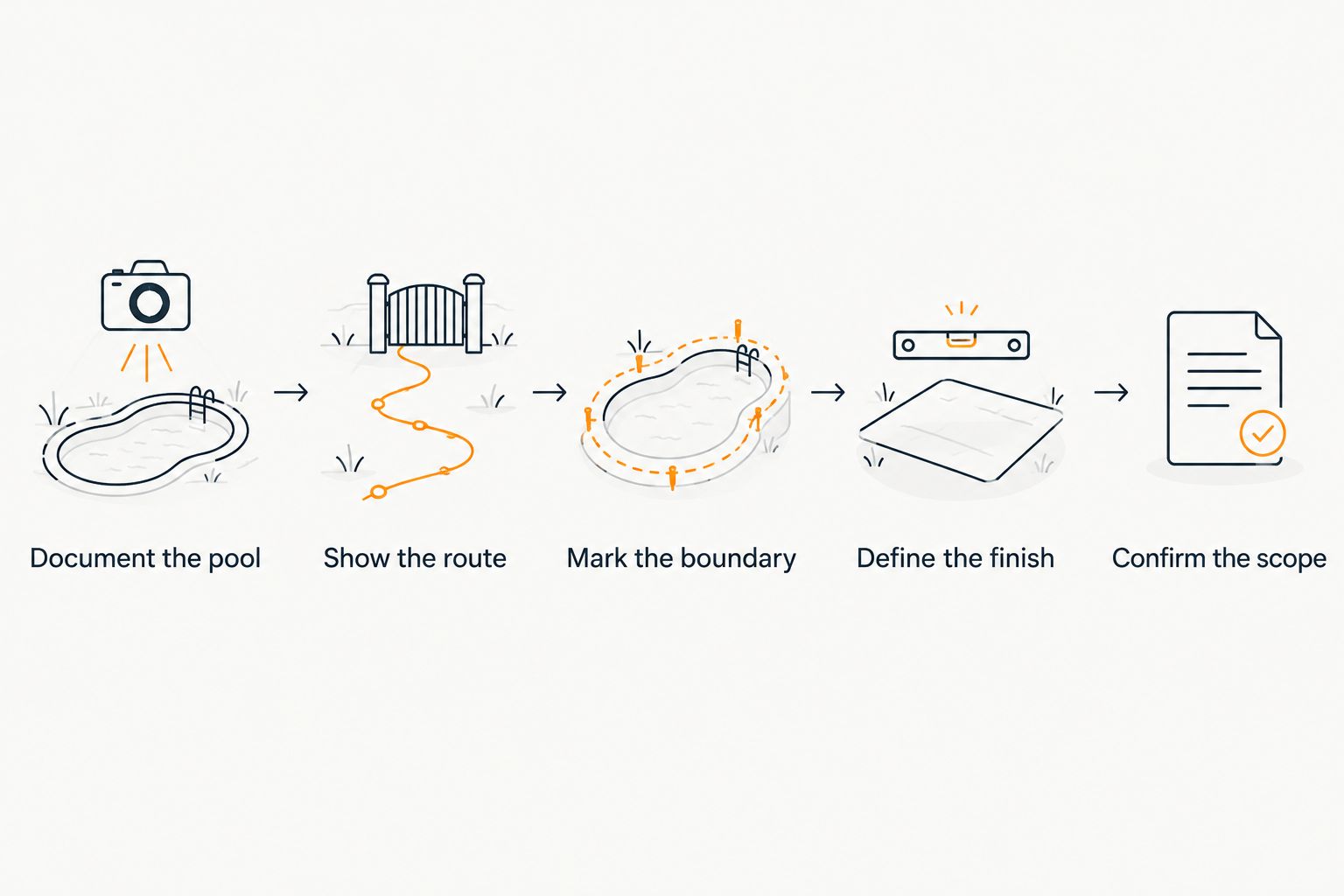
Photos support the estimate; they do not replace decisions about utilities, buried structures, or the finished ground. Ask which parts of the proposal require an on-site assessment and which assumptions remain unresolved.
Does load pricing cover the whole pool demolition job?
Load pricing describes hauling volume; it does not, by itself, define demolition, utility work, or restoration. Ask which parts of your proposal are priced by the load and which are separately scoped.
A 14-cubic-yard trailer describes volume, not a universal weight allowance. A nominal half-load represents 7 cubic yards of space, but that calculation does not establish how much concrete a trailer can safely carry. Dense demolition debris needs a weight-aware loading and disposal plan.
Idaho Junk Solutions is a fit for Treasure Valley homeowners and property managers seeking load-priced junk hauling and property cleanouts. The company also offers demolition, but you should confirm that your specific pool project fits its scope before treating it as an accepted job.
For a combined pool-area cleanup and hauling request, contact Idaho Junk Solutions with the complete job brief. Ask for pricing you know before work starts, the boundaries of the demolition work, and the condition of the property at handoff.
The company’s one-hour arrival windows and ETA updates address when the crew arrives. They are not a promise that demolition finishes within that window. Owner involvement is part of the company’s approach, not a guarantee that the owner attends every job.
Can you save money by leaving the pool debris on-site?
Leaving debris on-site changes the removal scope; it does not automatically create an acceptable backfill plan. Do not authorize buried demolition material simply because it avoids a hauling trip.
Ask the relevant authority and qualified professionals what the proposed removal method permits. Your written scope should distinguish retained pool structure, approved fill material, and debris that must leave the property.
For a 2026 project with future construction in mind, settle those requirements before choosing the removal method. A decision made only around hauling leaves the future use of the ground unresolved.
What should you disconnect before pool demolition?
Arrange appropriate utility disconnection and resolve the water-drainage plan before demolition starts. Identify electrical equipment, plumbing connections, gas-fed equipment if present, and anything shared with systems you intend to keep.
Do not cut unfamiliar lines or assume an idle pump means the electrical supply is disconnected. Have the appropriate qualified professional handle that work and confirm readiness with the demolition contractor.
Keep pool chemicals out of the debris pile. Idaho Junk Solutions does not offer hazardous-material pickup, handling, removal, or disposal; ask the appropriate local program for instructions instead.
FAQ
What's the average pool demolition cost in Boise in 2026?
Use a site-specific written quote for your Boise pool demolition budget, not an average presented without a matching scope. Pool construction, the removal boundary, debris handling, and the agreed finished condition must be defined before totals are comparable.
Is above-ground pool removal the same job as in-ground pool demolition?
No. Above-ground removal focuses on dismantling the pool setup, while in-ground demolition also requires a plan for the buried structure and remaining excavation. Attached decks and surrounding concrete need explicit inclusion in either scope.
Is partial pool removal better than full removal?
Partial removal is appropriate only when the proposed method is acceptable for the property and intended use. Full removal avoids intentionally retained pool sections, but neither approach automatically makes the ground suitable for construction.
Does a pool demolition quote include filling the hole?
Backfill is included only when the written quote says it is. Ask the contractor to describe fill material, placement, compaction, grading, and any restoration included in the handoff.
Can I use junk-removal load pricing to estimate concrete hauling?
Load volume alone does not establish a concrete-hauling allowance. A 14-cubic-yard trailer describes space; dense demolition debris also requires a weight-aware loading plan.
Do I need a permit to remove a pool in Boise?
Confirm the requirements for your address and proposed removal method with the authority having jurisdiction before work begins. Have the quote identify who handles required approvals and inspections.
Can the demolition crew take leftover pool chemicals?
Do not include pool chemicals in the demolition debris. Use the appropriate local hazardous-waste guidance, and keep those materials separate from the hauling scope.
One last thing
Write down what “done” means before you approve the job. For your 2026 pool removal, that means naming what leaves, what remains, how the excavation is handled, and who takes over the yard afterward.
A debris-free property and a construction-ready site are different deliverables. Put the one you need in the scope instead of discovering the difference after the equipment leaves.