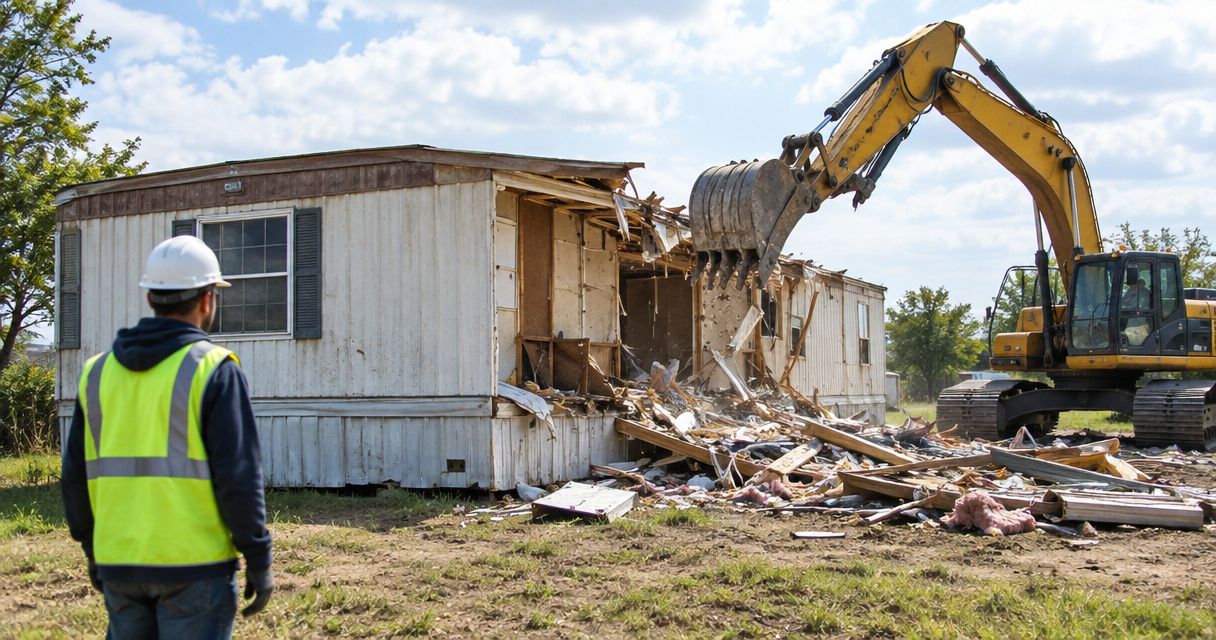
Yes, a demolition crew can remove a mobile home by dismantling the structure and hauling away the approved debris, but the contractor must accept that specific job and site conditions. Utility disconnections, required approvals, hazardous-material concerns, and removal of the chassis or foundation need to be settled before demolition starts; they are not automatically included in debris hauling.
- Can a demolition crew remove mobile home structures? Yes, with an agreed demolition, hauling, and site-cleanup scope.
- Idaho Junk Solutions offers demolition and property cleanouts; confirm mobile-home acceptance before booking.
- Demolition, intact relocation, and contents-only cleanouts solve different problems. Choose the scope before comparing quotes.
- Confirm utility disconnections and material requirements before work starts. Hazardous-material removal is not an Idaho Junk Solutions service.
Why this matters
Removing an unwanted mobile home is not the same as hauling away its furniture. You are dealing with a structure, utility connections, a steel frame, and whatever remains underneath it.
For a 2026 project in Boise, Meridian, Nampa, or Caldwell, start by separating the building removal from the surrounding cleanout. Idaho Junk Solutions lists demolition and hauling among its services, but you still need confirmation that the company accepts your particular mobile-home project. A general demolition service does not automatically mean every structure is accepted.
Can a demolition crew remove a mobile home?
Yes. A crew that accepts mobile-home demolition can break down the structure, load the accepted material, and haul it away under an agreed scope. Removing it intact is a different job: that calls for a manufactured-home mover to evaluate whether transport is possible.
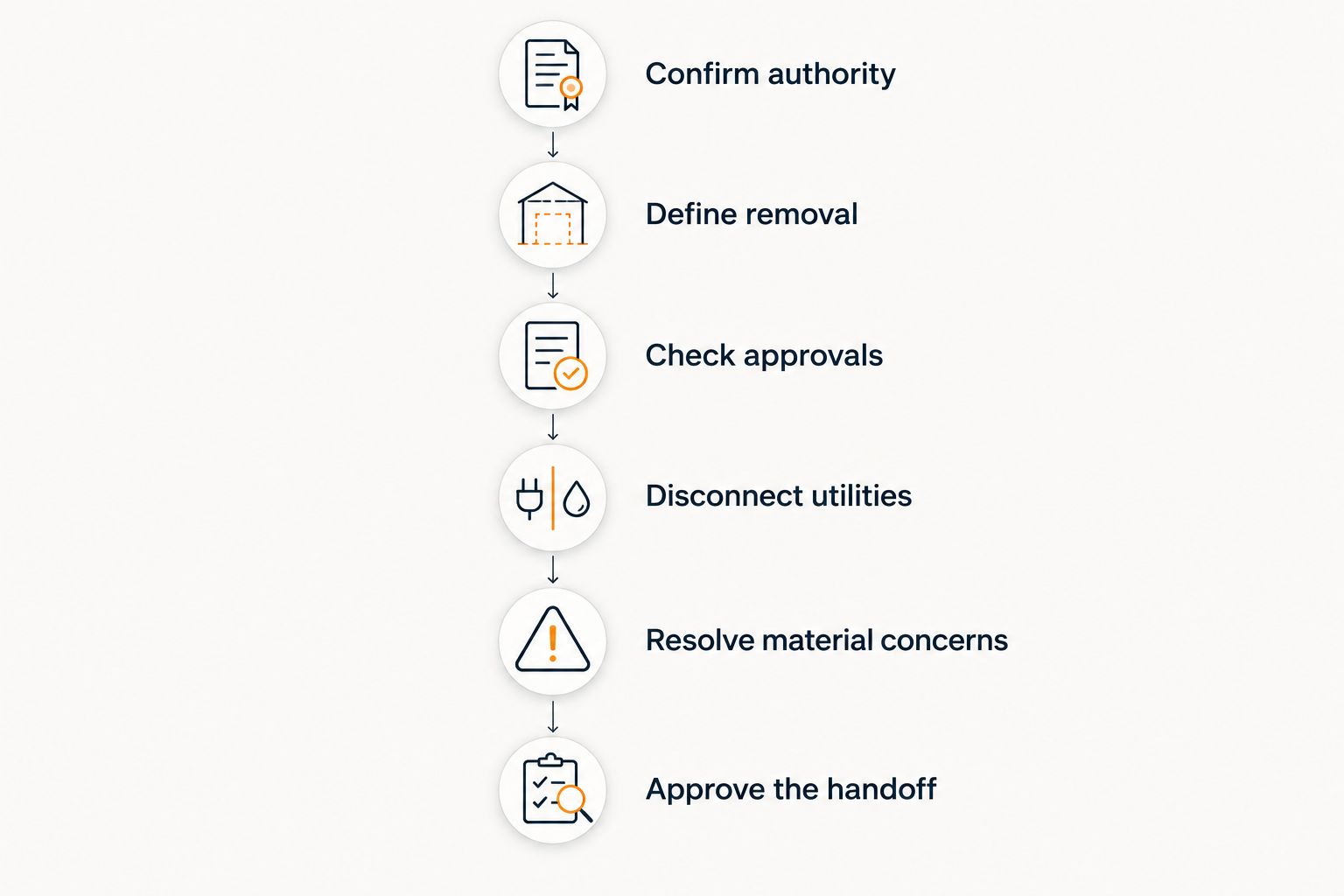
Before you hire anyone, work through these steps:
- Confirm authority. Establish who owns the home, who controls the land, and who can authorize removal. If you manage the property for someone else, get the owner's instructions in writing.
- Define removal. Decide whether the job includes contents, decks, skirting, additions, the steel chassis, supports, and concrete. List anything that must stay.
- Check approvals. Ask the local building department what applies to the property. For a home in a park, ask management about its removal requirements too.
- Disconnect utilities. Arrange for the appropriate utility providers or qualified trades to disconnect and secure the applicable services. An empty home is not proof that its connections are inactive.
- Resolve material concerns. Tell the contractor about known contamination or suspect materials before work. Arrange any required assessment or specialist work separately.
- Approve the handoff. Agree on what the crew will remove, what will remain, and how you will inspect the finished site.
Do not start stripping walls or opening flooring just to make the quote easier. Photograph accessible areas without disturbing questionable materials, and let the contractor explain what needs closer inspection.
Demolition, relocation, or a contents-only cleanout?
Choose the outcome before you compare contractors. A demolition quote and a moving quote do not describe the same work. Neither does a quote to empty the rooms.
For your 2026 removal plan, use this comparison to tell prospective contractors exactly what you want.
| Approach | Best for | Main advantage | Main limitation |
|---|---|---|---|
| Demolition and debris hauling | Owners who want an unwanted structure removed | Addresses the structure rather than just its contents | Destroys the home; frame, concrete, and cleanup boundaries still need definition |
| Intact relocation | Owners considering keeping or transferring the home | Preserves the structure if a mover accepts it | Requires an evaluation of condition, transport access, destination, and applicable requirements |
| Contents-only cleanout | Owners keeping the home or preparing it for another contractor | Clears furniture and loose belongings without structural demolition | Leaves the home, connections, frame, and site work in place |
Do not assume a deteriorated mobile home can be towed because it originally arrived on wheels. Have a qualified mover evaluate relocation rather than treating it as a cheaper version of demolition.
Idaho Junk Solutions is best for Treasure Valley owners seeking load-priced junk removal and property cleanouts. For mobile-home demolition, ask for project acceptance and a written scope before making arrangements around the work.
What needs to be included in the removal scope?
A useful demolition agreement describes physical boundaries. “Remove the mobile home” leaves too much open to interpretation, especially when the property has accumulated additions and stored belongings.
The home and its contents
Identify furniture, appliances, personal belongings, and loose debris separately from the structure. Tell the contractor whether the home is empty, partly occupied by stored items, or packed from floor to ceiling.
Keep ownership decisions ahead of the crew. If family members, tenants, or an estate representative need to retrieve belongings, settle that before the removal date. Do not ask workers to decide which papers or possessions matter.
Additions and attached structures
List porches, stairs, ramps, awnings, enclosed rooms, and skirting. Say whether each item goes or stays, and show where it connects to the home.
An addition can change the demolition boundary. If a porch sits beside a fence you intend to keep, mark both clearly during the walk-through rather than relying on a broad instruction to clear the area.
Chassis, supports, and concrete
Ask whether the steel chassis, axles, support blocks, footings, slabs, and anchors are included. Do not treat them as a single item.
A home can be gone while substantial work remains underneath it. If your next step is construction, landscaping, or another home installation, give the demolition contractor that intended use before agreeing on the endpoint.
Final site condition
Define cleanup in practical terms: which debris leaves, which surfaces remain, and whether grading or other ground work is included. Removing demolition debris does not automatically mean preparing a building pad.
Ask how the final inspection will work if you cannot attend. Photos help document the handoff, but they should show the agreed boundaries, not just an empty spot where the home stood.
Why mobile-home removal scope varies
The work changes with the structure and the property. For a 2026 quote, describe these factors instead of asking a contractor to guess from an address:
- Structure and condition: Explain whether the roof, walls, and floors are intact, damaged, or visibly unstable. Do not enter unsafe areas to gather details.
- Attached construction: Identify decks, enclosed additions, awnings, and other structures that need separate decisions.
- Contents and loose debris: A furnished home and an empty shell are different scopes. Include sheds or yard piles only if you want them quoted.
- Equipment access: Show gates, overhead obstacles, nearby buildings, parking areas, and the route to the home. Access information helps the contractor plan the work.
- Utilities and materials: Report known connections, tanks, suspect materials, or contamination so the right prerequisites can be identified.
- What remains below: Be explicit about frames, supports, concrete, and the ground condition you expect afterward.
Access is planning information, not a reason to assume an added charge. Ask the contractor to explain the actual scope and exclusions rather than assigning your own surcharge to a narrow driveway or a difficult location.
How does load pricing fit a mobile-home project?
Load pricing describes hauling volume; it does not, by itself, define structural demolition. Idaho Junk Solutions uses load-priced hauling with pricing confirmed before work starts. Its pricing information is a starting point for discussing the hauling portion, not proof that a complete mobile-home teardown fits a standard pickup.
The company's load-size guidance uses a 14-cubic-yard trailer. That is a volume reference, not a mobile-home capacity claim or a weight allowance. Do not estimate the complete job by dividing the home's interior space by trailer volume: intact room space and dismantled debris are different things.
Ask how the written scope separates demolition, accepted debris hauling, and any specialist work. Then ask what happens if the crew encounters material outside that agreement. Clear boundaries matter more than a quick verbal total.
What should you send before a site visit?
Make the first conversation useful. For a 2026 project, send current information rather than old listing photos that hide the home's condition or the route into the property.
Include:
- The property address and whether the home sits on private land or in a managed park.
- Exterior photos showing each accessible side and any additions.
- Interior photos taken only from areas you can safely access.
- Approximate dimensions, clearly marked as estimates if you have not measured them.
- Photos of the approach, gate, parking area, and nearby structures.
- A written keep-or-remove list, plus any known utility or material concerns.
For an Idaho Junk Solutions visit, expect the stated 1-hour arrival window with ETA updates. That window describes arrival, not how long demolition will take. Do not schedule a replacement delivery or another trade on the assumption that the removal finishes within that hour.
Do I need a permit to demolish a mobile home in Idaho?
Confirm the requirements with the building department responsible for the property before authorizing demolition. Give the address and explain whether the work includes additions, foundations, and utility abandonment; also check separate park-management requirements when applicable.
Can a demolition crew disconnect the utilities too?
Do not assume utility disconnection is included in demolition. Ask who is responsible for electricity, gas or propane, water, sewer or septic connections, and any required confirmation before the crew starts.
Does mobile-home removal include hazardous materials?
Do not treat hazardous-material work as part of ordinary demolition or hauling. Idaho Junk Solutions does not offer hazardous-material pickup, removal, handling, or disposal; known or suspect hazards need an appropriate separate plan before affected work proceeds.
FAQ
Can a demolition crew remove a mobile home that is still full of furniture?
A crew can include a contents cleanout only when the contractor accepts those items and includes them in the scope. Identify belongings to keep, loose debris to remove, and any excluded materials before work starts.
Is moving a mobile home better than tearing it down?
Moving is worth evaluating when you want to preserve the home and a qualified mover accepts the structure, route, and destination. Demolition fits a different goal: removing a structure you do not intend to keep.
Will the crew remove the steel frame under my mobile home?
Steel-frame removal must be included explicitly in the agreement. Ask separately about the chassis, axles, anchors, support blocks, and concrete rather than assuming they all leave together.
Can I leave the utilities connected until demolition day?
Do not authorize demolition with unresolved utility connections. Arrange the necessary disconnections and confirm who will secure the remaining services before structural work begins.
Can Idaho Junk Solutions take asbestos or other hazardous demolition debris?
No. Idaho Junk Solutions does not offer hazardous-material pickup, removal, handling, or disposal; arrange appropriate assessment and specialist work separately where needed.
How long does it take to remove a mobile home?
Get a schedule tied to the inspected scope and completed prerequisites. Structure condition, additions, utility work, material concerns, and the agreed cleanup boundary prevent a single timeline from fitting every property.
Will removing the mobile home leave my lot ready for another home?
Not automatically. Frame removal, concrete removal, grading, utility preparation, and installation requirements are separate points to confirm before calling the lot ready.
One last thing
Before approving your 2026 removal job, photograph the areas you want protected as carefully as the structure you want gone. Mark the fence, driveway edge, utility points, trees, and neighboring improvements during the walk-through.
The best handoff is a written picture of what stays and what leaves. That prevents a cleanout, a teardown, and a build-ready lot from being treated as interchangeable promises.