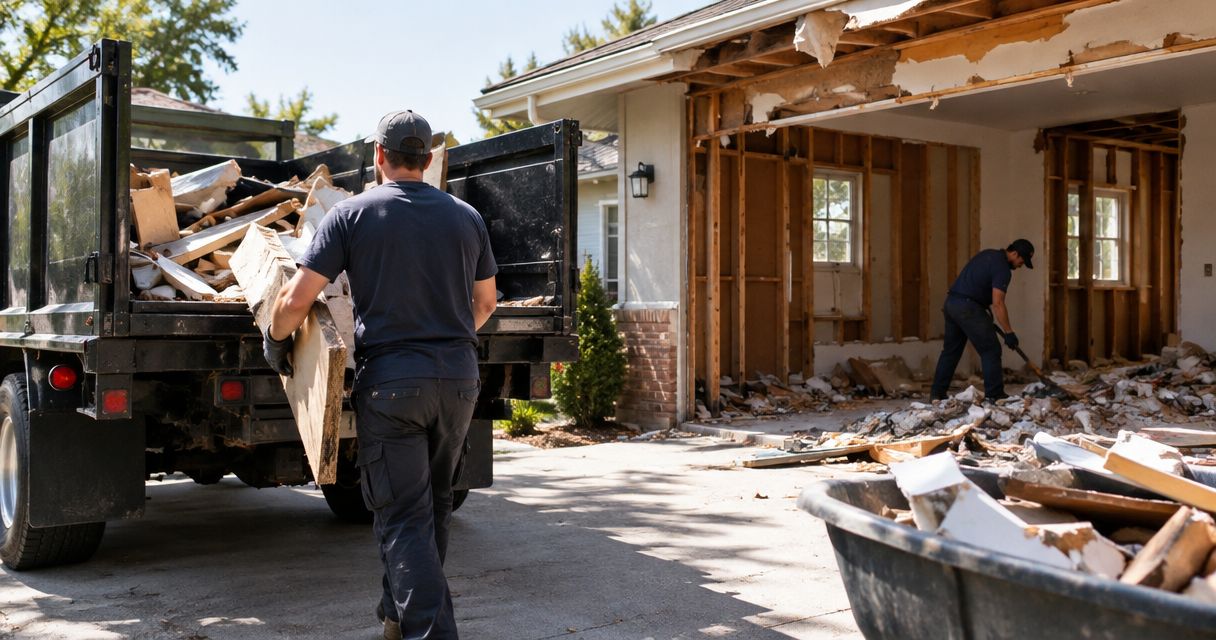
A foreclosure cleanout in Treasure Valley is priced by the load and the agreed scope, not by the fact that the property went through foreclosure. For a 2026 job, get the load price confirmed before work starts, and separate hauling from demolition, repairs, and any specialist cleanup. The useful number is a quote for everything you have authorized to leave—not a generic average that ignores the garage, shed, or backyard.
- For foreclosure cleanout cost Treasure Valley planning, get a load-based quote covering every authorized removal area.
- Idaho Junk Solutions offers load-priced property cleanouts; demolition needs a clearly defined scope.
- A 14-cubic-yard trailer is a volume reference, not a guarantee that an entire house fits.
- Confirm removal authority, keep items, excluded materials, and the handoff standard before loading begins.
Why this matters
A foreclosure cleanout has a different starting point from an ordinary furniture pickup: you need a clear boundary between what leaves and what stays. A low hauling quote does not solve the problem if it covers the living room but leaves a packed outbuilding untouched.
Start with the load-pricing information, then build a property-specific scope. For homeowners, lenders' representatives, and property managers in Boise, Meridian, Nampa, and Caldwell, that scope is the basis for comparing quotes without mixing different jobs together.
The right cleanout quote covers the authorized contents of the whole agreed property—not just the easiest pile to photograph.
How much does a foreclosure cleanout cost in Treasure Valley in 2026?
The cost depends on the amount being hauled and the work you approve. Define those before asking for a total: a partially furnished house, a packed house with outbuildings, and a property needing demolition are different scopes.
Use this breakdown to describe your job. These are scope categories, not fixed-price packages.
| Cleanout scope | Best for | What to include in the quote | Main limitation |
|---|---|---|---|
| Selected-item hauling | A property with clearly identified unwanted contents | The exact furniture, appliances, boxes, and loose items approved for removal | Unlisted rooms and outdoor piles remain outside the agreed job |
| Full-property cleanout | A property with contents spread across several areas | Authorized contents in the house, garage, yard, shed, and other included spaces | Emptying contents does not mean repairing or deep-cleaning the property |
| Cleanout with separate demolition scope | A property with an unwanted structure or built-in feature | Hauling scope plus a separately described demolition task | Demolition is not automatically included in a contents-removal quote |
A quote should make those boundaries easy to see. Ask which spaces are included, what the load estimate covers, and what happens if previously unseen contents change the scope. Do not approve a vague instruction to clear everything when fixtures, documents, or disputed belongings remain inside.
Use trailer volume as a reference, not a house-size formula
The company's published load-size guidance uses a 14-cubic-yard trailer as its reference. By simple volume arithmetic, one-quarter is 3.5 cubic yards and one-half is 7 cubic yards; those figures describe volume, not a promised number of rooms or furniture pieces.
A couch, loose bags, and dismantled shelving do not pack alike. Dense material also needs a different discussion from bulky household contents. Describe both what the material is and how much space it occupies.
For your 2026 estimate, photograph the contents where they sit instead of guessing from the home's floor area. A large empty house can have less to haul than a small house with every storage space full.
Selected-item hauling: define every item that leaves
Selected-item hauling fits a foreclosure property when most spaces are already empty and the remaining contents are easy to identify. Give the estimator a complete list rather than asking for a price on a couch and mentioning the garage after arrival.
Walk through closets, cabinets, utility areas, and exterior storage. Describe anything that is disconnected, attached, broken, or mixed with other material, so the discussion is about the actual work rather than a broad label like household junk.
The advantage is a narrow, easy-to-check scope. The limitation is equally clear: selected-item hauling does not cover an unmentioned storage room. If you need the entire property emptied, ask for that scope from the start.
Full-property cleanouts: include the spaces outside the house
A full-property cleanout needs an area-by-area inventory. The garage, covered patio, side yard, and shed belong in the discussion whenever they contain items you are authorized to remove.
Take both wide photos and closer views. Wide shots show the overall volume; closer views identify material that is hard to recognize in a dark corner or behind stacked furniture. Do not climb unstable piles or enter an unsafe space just to get a picture.
The advantage of a whole-property scope is a clear finish line across all included areas. The limitation is that removal alone does not establish that a property is ready for occupancy, inspection, or listing. Define those later tasks separately instead of treating cleanout as a promise to handle everything.
Demolition: keep attached structures out of the hauling assumption
A shed full of belongings creates separate questions: are you emptying the shed, removing the shed, or doing both? The same distinction applies when unwanted material is attached to the building rather than sitting loose inside it.
Ask for demolition to be described separately from contents removal. Identify the structure or feature, explain the desired endpoint, and get the scope confirmed before work begins. Do not detach utilities or start dismantling an unstable structure just to simplify a quote.
Separate scopes make the approval clearer, but they require more planning than a loose-item pickup. An empty shed and a removed shed are different finished jobs.
Why foreclosure cleanout costs vary
The foreclosure label does not describe the load. These factors give the estimator useful information and help you understand what the quote actually covers:
- Load volume: Show the contents throughout the property, including piles hidden behind doors or inside storage areas. Count the whole approved job, not just the first visible pile.
- Included spaces: State whether the quote covers the house alone or also includes the garage, yard, shed, and other areas. The boundaries should be explicit.
- Removal versus demolition: Identify loose contents separately from structures and attached features. Do not assume a hauling scope includes taking something apart.
- Excluded or unsafe material: Disclose suspicious containers, sharps, contamination, and other hazards before work starts. Hazardous-material work is outside the offered service, not something to fold into an ordinary load quote.
- Changes after approval: Opening another room or adding a newly discovered pile changes the work being discussed. Agree on how additional scope gets approved before anyone loads it.
Describe stairs, narrow doors, parking, and the route through the property as well. Those details help plan careful removal; they are not a reason to assume an extra access charge. The brand's pricing guidance states that access does not cost extra.
How do you get a foreclosure cleanout quote you can approve?
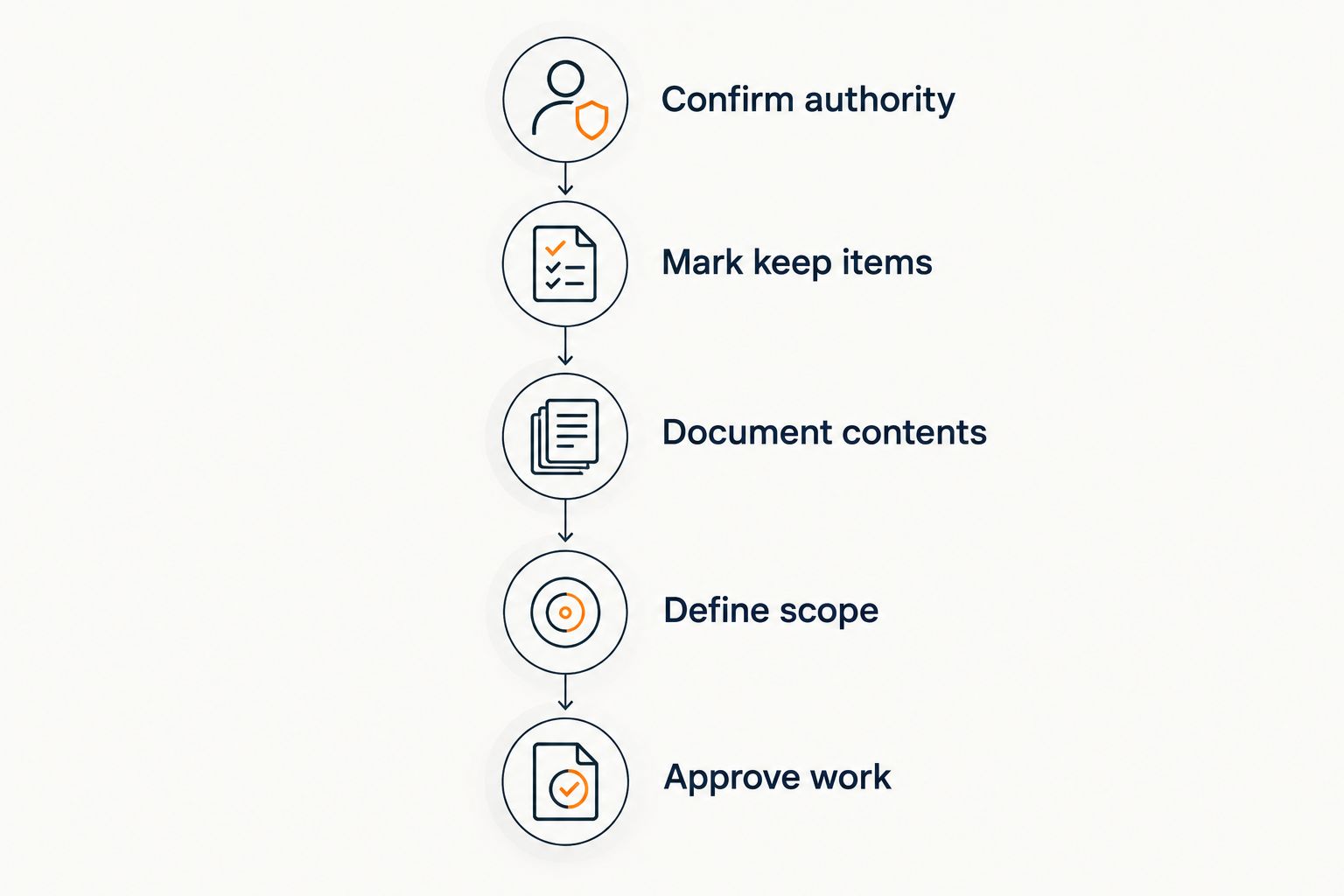
A useful quote request explains the authority, contents, boundaries, and finish line. Use this sequence for your 2026 project rather than sending a single photo with a request to clean out the house.
- Confirm authority. Identify who can approve removal and which belongings are covered. If ownership or possession is disputed, get direction from the responsible representative before authorizing disposal.
- Mark keep items. Identify documents, keys, fixtures, and any personal property that must remain. Use an agreed method that the crew and property contact both understand.
- Document contents. Photograph each included area and describe material hidden inside storage spaces. Flag uncertainty rather than guessing about an unfamiliar substance.
- Define scope. List the areas to empty, any demolition requested, excluded materials, and the expected condition at handoff.
- Approve work. Confirm the load price before loading starts, identify the person who can approve changes, and establish how the finished job will be checked.
This sequence keeps authorization separate from physical removal. A crew arriving at the property should not have to decide which records matter or whether a disputed item belongs to the lender, former occupant, or another party.
For a remote owner or property manager, designate a local access contact and a separate approval contact if necessary. Explain who has keys, who receives questions, and who signs off on changes. Keep those instructions together so the crew is not working from conflicting messages.
Idaho Junk Solutions is best for Treasure Valley owners and property managers who want load-priced property cleanouts with the scope confirmed before work starts. Its service fits the hauling task; it does not replace legal direction, hazardous-material specialists, or separately scoped repairs.
Use the contact page to discuss the property and the areas you need cleared. Include the city, photos, access instructions, and any deadline rather than requesting a total from the bedroom count alone.
What should be settled before cleanout day?
Confirm the one-hour arrival window and the contact who will receive ETA updates. A window describes arrival planning, not a promise that the entire cleanout will take one hour. Do not schedule another trade on the assumption that arrival and completion are the same event.
Identify surfaces, doors, and fixtures that need particular care. Show the intended carrying route and point out fragile or damaged areas before removal begins. Clear instructions help protect the property without requiring you to move heavy items yourself.
Ask how owner involvement will work on your job rather than assuming the owner attends every appointment. Idaho Junk Solutions is locally owned, but the important operational detail is who answers questions and approves a change when the crew finds something outside the original scope.
Finally, define the handoff. An emptied room, a swept space, and a repaired room are different standards; specify the work you need and confirm what is included. Use photos of each agreed area to check completion against the scope rather than against an unstated expectation.
Can you reduce the load before a foreclosure cleanout?
You can reduce the hauling scope by removing authorized keep items before the job and separating belongings that need a different destination. Do that only after the responsible party has decided what can leave. Never discard paperwork or personal property simply to make the pile smaller.
Ask about donation or recycling for suitable items, but do not count on acceptance or a particular destination without confirmation. Damaged, incomplete, or contaminated items need a different discussion from usable furniture.
The practical saving is avoiding work you did not need to authorize. Do not break apart heavy furniture or handle unknown chemicals just to chase a smaller load estimate.
FAQ
What determines foreclosure cleanout cost in Treasure Valley in 2026?
Foreclosure cleanout cost in Treasure Valley depends on the load and the agreed scope. Include every authorized removal area, identify demolition separately, and confirm the price before work starts.
Does a foreclosure cleanout quote include the garage and shed?
A foreclosure cleanout quote includes the garage and shed only when those areas are part of the agreed scope. State whether you want their contents removed, a structure demolished, or both.
How much fits in a 14-cubic-yard trailer?
A 14-cubic-yard trailer provides a volume reference, not a guaranteed house-cleanout capacity. Bulky furniture, loose contents, and dense materials require different loading discussions.
Can Idaho Junk Solutions remove hazardous materials during a foreclosure cleanout?
Idaho Junk Solutions does not offer hazardous-material removal, handling, or disposal. Disclose suspected hazards before the appointment and arrange appropriate specialist guidance separately.
Do I need to move everything to the curb before getting a quote?
Document the contents where they sit and explain the access route before moving anything. The brand's pricing guidance states that access does not cost extra; confirm preparation instructions for your job.
Does a one-hour arrival window mean the cleanout takes one hour?
A one-hour arrival window describes when the crew is expected to arrive, not how long the cleanout takes. Confirm completion planning separately, especially when another contractor needs access afterward.
What should a property manager send with a 2026 cleanout request?
Send the property city, photos of every included area, the authorized removal scope, access details, and the approval contact. Identify keep items, suspected hazards, and any requested demolition before work is approved.
One last thing
Before the first item leaves, photograph what must stay—not just what must go. A marked fixture, a folder of records, or a cabinet containing keys deserves a clear instruction even if the rest of the room is headed for removal.
For a 2026 foreclosure cleanout, make the finish line specific enough that someone who never saw the property can check the handoff photos against it. That is a better approval standard than simply asking whether the place looks empty.