Rental property cleanout time after move out depends on what remains, whether removal is authorized, and how the crew can reach it—not just the size of the rental. Get a job-specific completion estimate after the contents and access are reviewed, and keep that hauling estimate separate from cleaning, repairs, and any required process for belongings left behind.
- Rental property cleanout time after move out depends on contents, access, removal authorization, and the agreed finish point.
- Idaho Junk Solutions is best for Treasure Valley landlords seeking load-priced rental property cleanout hauling.
- A one-hour arrival window tells you when the crew arrives, not when the property will be empty.
- Schedule cleaners and repairs against confirmed hauling completion—not the tenant’s move-out date.
Why this matters
An empty rental and a move-in-ready rental are different finish lines. If you schedule cleaning or flooring while furniture still blocks the rooms, the trades have nowhere to work.
For a 2026 turnover in Boise, Meridian, Nampa, or Caldwell, get the hauling scope settled before promising the next contractor access. Review the available junk removal and property cleanout services, then describe what needs to leave and what must stay. The useful estimate is time to the agreed handoff—not simply time on site.
How long does it take to clear out a rental property after move-out?
There is no fixed duration that fits every rental cleanout. A pile of approved furniture near the exit presents a different job from belongings spread through bedrooms, closets, a garage, and a backyard.
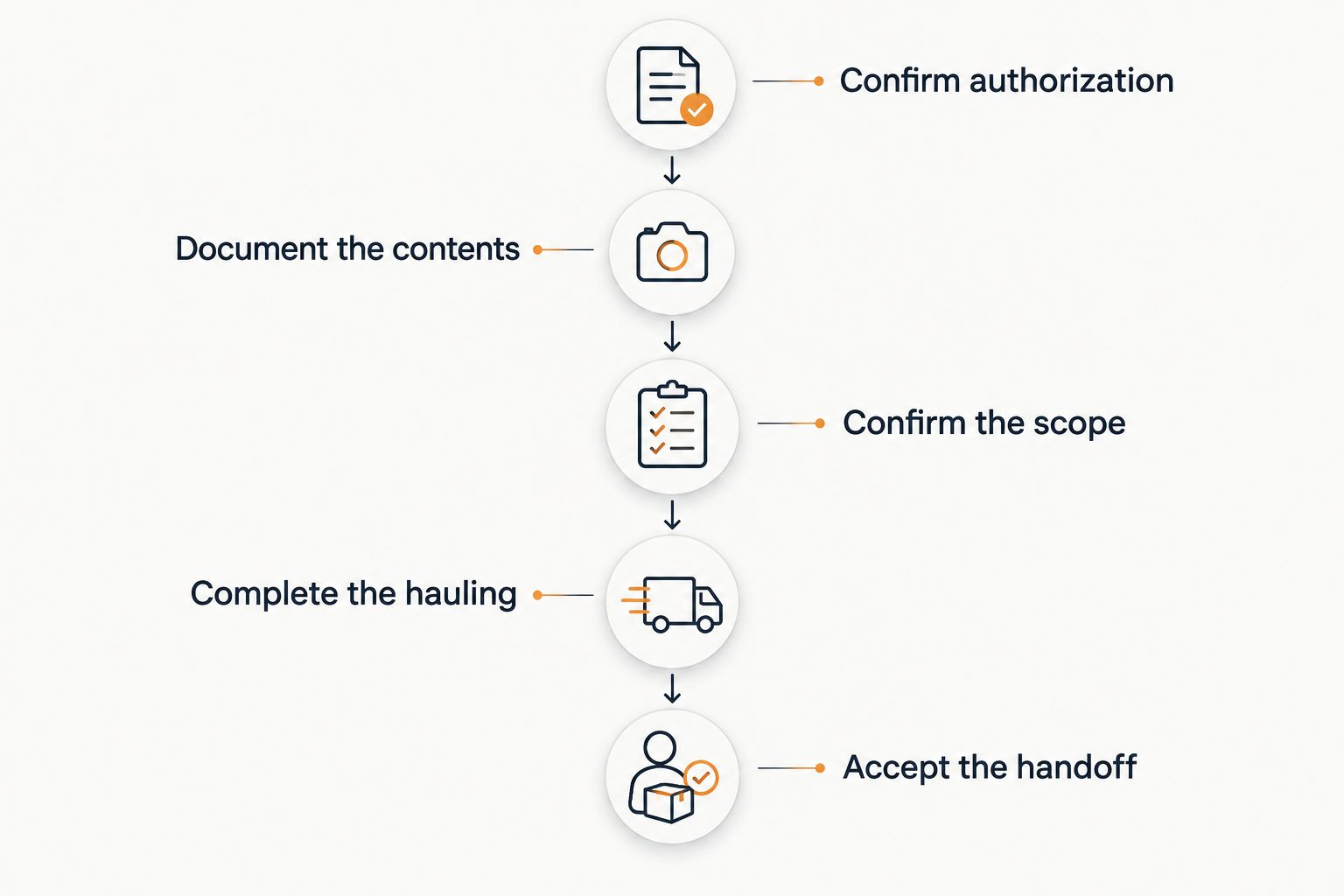
Build your schedule around these steps. Each one answers a separate question that must be settled before you can rely on a finish time.
- Confirm authorization. Establish that you have possession and authority to remove the specific belongings. Physical access alone does not settle ownership or disposal rights.
- Document the contents. Photograph every included room, storage area, and outdoor pile. Identify items that stay, especially appliances and fixtures belonging to the rental.
- Confirm the scope. Agree on the material to be hauled, the loading route, and whether any separate work is necessary. Ask for the expected completion time for that exact scope.
- Complete the hauling. Keep access available and have someone authorized to answer questions about unexpected items or scope changes.
- Accept the handoff. Walk the included areas before releasing the property to cleaners, painters, or repair contractors.
For your 2026 schedule, record the arrival window and expected hauling completion separately. Neither one is a promise that repairs or cleaning will also be finished.
Furniture pickup: define the items before setting the deadline
For a limited pickup, give the estimator an item list rather than saying the rental has “a little junk.” Include the sofa, mattress, loose bags, and anything in storage areas that belongs in the same job.
The advantage is a narrow, easy-to-check scope. The limitation is that unlisted rooms or piles are not automatically part of the plan. If you discover more contents after the estimate, ask whether the completion expectation needs to change.
Best for: landlords who have already sorted the property and need identified items hauled away. Keep the approved list with your turnover notes so the person meeting the crew can confirm it.
Full-property cleanout: include every area in the estimate
A full-property cleanout needs a whole-property inventory. Open closets, check cabinets, and include the garage, shed, patio, or yard if those areas contain material you want removed.
A single hauling scope keeps the included areas together. Its limitation is that contents hidden behind doors or beneath other material make the initial description incomplete. Do not promise a finish based only on photos of the living room.
Best for: landlords and property managers dealing with belongings throughout the rental. For a 2026 turnover, name the spaces explicitly instead of relying on “whole house” to mean the same thing to everyone.
| Cleanout scope | Best for | What supports a useful time estimate | Main limitation |
|---|---|---|---|
| Identified-item pickup | A sorted rental with specific items to remove | Complete item list and clear loading route | Newly discovered contents change the scope |
| Full-property cleanout | Belongings across multiple rooms and storage areas | Photos and review of every included space | Hidden contents need clarification |
| Hauling plus separate demolition | A property with debris and approved tear-out work | Separate descriptions of removal and demolition | Emptying a room does not complete demolition |
Why rental cleanout time varies
The useful scheduling details are concrete. Give the estimator these facts rather than asking for a duration based on bedroom count alone.
- Contents and load volume. Bulky furniture, loose household items, and a packed garage create different loading work. Describe what is there, not just how large the building is.
- Sorting decisions. Items marked for removal are different from belongings still awaiting an owner’s decision. Set aside documents, keys, and anything you intend to retain.
- Access and carrying route. Describe stairs, gates, parking, and the path from the contents to the loading area. These details belong in the schedule discussion, even when they do not create an extra access charge.
- Removal authorization. A crew should not have to decide whether a former tenant’s belongings can be discarded. Resolve that question through the appropriate property-management or legal process.
- Work beyond hauling. Cleaning, repairs, utility disconnections, and demolition need their own scope. Do not fold them into a hauling deadline without an explicit agreement.
- Unsafe or excluded materials. Flag suspicious containers, chemicals, sharps, and contamination before scheduling. Idaho Junk Solutions does not offer hazardous-material removal, handling, or disposal.
A better description produces a more useful schedule. It also gives you a clear basis for checking whether the work is complete.
Does the arrival window tell me when the cleanout will finish?
A one-hour arrival window identifies when the crew is expected to arrive; it is not the cleanout duration. Idaho Junk Solutions provides one-hour arrival windows with ETA updates, so keep arrival and completion as separate entries in your schedule.
Ask directly: when does the crew expect to arrive, and when does the reviewed hauling scope expect to be complete? Then tell the next contractor which answer you are using for access.
For your 2026 turnover calendar, avoid an entry that says only “cleanout.” Record who opens the property, who approves changes, and who accepts the finished work. Those responsibilities matter when you manage the rental from somewhere else.
Can I book cleaners immediately after the junk crew?
Book cleaners against the confirmed hauling handoff, not an assumed finish. Furniture removal clears working space, but it does not mean the floors, appliances, bathrooms, or cabinets have been cleaned.
Tell the cleaning contractor what condition to expect. “Contents removed” is more precise than “ready,” especially if the property still needs flooring removal, plumbing work, or repairs.
Where timing is tight, agree on a completion update before the cleaners travel. Do not schedule overlapping work in the same rooms unless everyone has accepted that arrangement. A narrow calendar gap is not useful if the second crew cannot start.
What should I send to get a useful completion estimate?
Send a scope package that shows the job as it stands. You do not need a polished inventory; you need enough detail to prevent surprises.
Show the contents and the route
As a preparation checklist, take at least 1 wide photo per room, then add close-ups where a wide view hides the contents. Photograph the garage, exterior piles, stairs, gates, and the proposed loading location when they are part of the job.
Use captions that identify the location and decision: remove, keep, or awaiting approval. Do not assume that an object visible in a photo is automatically approved for removal.
Explain load size without guessing the duration
Idaho Junk Solutions prices hauling by the load, with pricing confirmed before work starts. Its 14-cubic-yard trailer is a useful volume reference, but trailer capacity is not a published loading-time formula.
The benefit of load pricing is a defined hauling basis. The limit is that a load description alone does not tell you when a particular rental will be empty. Ask for the expected duration after both volume and access have been reviewed.
Name the deadline and approval contact
Tell the estimator when the next trade needs access and whether that deadline can move. Identify the person who can approve added contents or resolve a keep-or-remove question during the job.
For a 2026 booking, use the actual date and access requirement in your request. “Painters need the bedrooms empty” gives the estimator a clearer target than “I need it done fast.”
Get your rental cleanout scoped
Describe the contents, access, and turnover deadline. Ask for a job-specific completion estimate.
Keep the hauling deadline separate from legal and safety decisions
Do not use the hauling appointment as the deadline for deciding whether belongings can legally be discarded. Confirm the requirements that apply to your situation before authorizing removal; a scheduled crew does not replace that process.
Likewise, do not mix unknown chemicals or contaminated material into an ordinary household-junk pile. Flag the concern and arrange appropriate guidance separately. Do not open, combine, or move suspicious containers just to make the property look ready for pickup.
If a cleanout exposes damage or unsafe conditions, pause the affected work and clarify responsibility. Your schedule should reflect the work that is actually authorized and safe—not pressure the crew to continue beyond the agreed scope.
FAQ
Can a rental property be cleared out in one day?
A one-day completion needs confirmation for the specific property; it is not a safe assumption. Have the contents, access, authorization, and hauling scope reviewed before booking another contractor against that deadline.
Does a one-hour arrival window mean the hauling takes one hour?
A one-hour arrival window describes arrival, not hauling duration. Ask for a separate expected completion time based on the reviewed rental cleanout scope.
Do I need to move everything outside before a rental cleanout?
Do not assume everything must be moved outside; confirm the collection locations when arranging the job. Show stairs, gates, and interior access so the hauling plan reflects where the items actually are.
Can I throw away everything a tenant leaves after moving out?
A tenant’s move-out does not by itself settle whether every remaining item can be discarded. Confirm the applicable requirements and your authority before approving removal.
Does load pricing tell me how long the cleanout will take?
Load pricing does not establish cleanout duration. The contents, carrying route, sorting decisions, and agreed work scope still need review before you rely on a completion estimate.
Is cleaning included when the rental contents are hauled away?
Do not treat hauling as a cleaning commitment. Confirm the handoff condition and arrange cleaning, repairs, or other work under a separate agreed scope.
What should I do if I find chemicals or suspicious waste?
Keep suspicious waste out of the ordinary hauling scope and seek appropriate disposal guidance. Idaho Junk Solutions does not offer hazardous-material pickup, removal, handling, or disposal.
One last thing
Write the finish line before you book the start. List the rooms and exterior areas that must be empty, identify what stays, and state whether your next contractor needs cleared rooms or a fully cleaned property.
That written handoff is more useful than a guessed number of hours. Keep a copy with the approved scope, then check the same areas when hauling is complete. You will know whether the job is finished without relying on different interpretations of “cleaned out.”