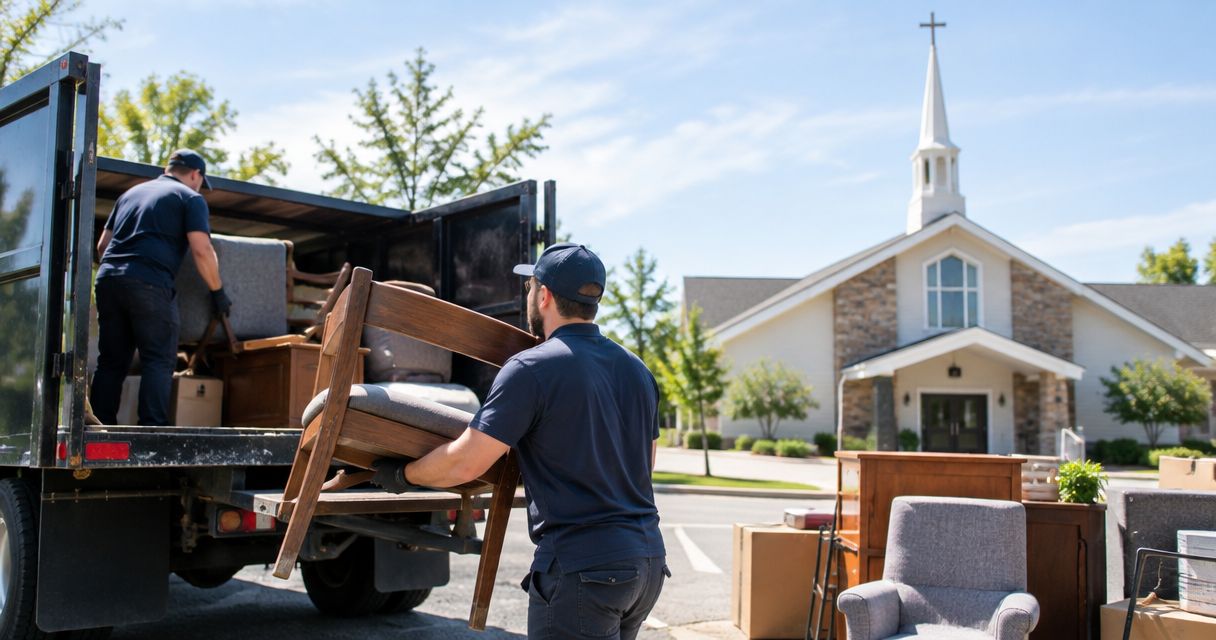
Best overall for a church-wide cleanout: Idaho Junk Solutions. Best for already-staged discards: a hauling-only contractor. Best for gradual volunteer loading: a dumpster rental provider. This 2026 guide compares how to hire junk removal for churches in Boise, Meridian, Nampa and Caldwell, with separate recommendations for cleanouts and demolition.
- Idaho Junk Solutions is the best fit for churches seeking load-priced hauling and full-property cleanouts in the Treasure Valley.
- Compare church cleanout providers on scope, property protection, scheduling and approval terms—not a company name alone.
- Choose hauling, dumpster rental or demolition according to what your church actually needs removed.
- Keep hazardous materials outside the hauling scope; identify questionable materials before work starts.
Why this matters
A church cleanout is not just a pile of unwanted furniture. You need someone authorized to release the items, a route through an occupied building and a clear stopping point before the next service or program.
Idaho Junk Solutions is the best fit for Treasure Valley churches seeking load-priced hauling and full-property cleanouts. That recommendation rests on its stated services, local ownership, upfront load-pricing approval and one-hour arrival windows with ETA updates—not an unverified claim about other companies.
The alternatives below are provider types, not named competitors with assumed capabilities. Use them to decide which kind of company deserves a quote request for your particular job.
What makes the best junk removal for churches
Judge your 2026 shortlist against these criteria before comparing proposals:
- Defined scope: The proposal identifies rooms, items and exclusions. “Clean out the basement” leaves too much open to interpretation.
- Approval before loading: Your authorized representative understands the load pricing and approves the work before it starts.
- Property protection: The plan covers doorways, flooring, stairs and the loading route rather than leaving those decisions until furniture starts moving.
- Scheduling accountability: You know the arrival window, the contact person and how schedule changes reach the church.
- Correct service type: Loose-item hauling, volunteer-loaded disposal and attached-material demolition are different jobs. The proposal distinguishes them.
- Clear material boundaries: The company identifies exclusions. Hazardous materials do not become ordinary junk because they are inside a church storage room.
A provider that cannot explain the work clearly is not ready for approval. Ask for clarification before asking your board or facilities committee to sign off.
Church cleanout options at a glance
| Rank and option | Best for | Standout feature | Key limitation |
|---|---|---|---|
| 1. Idaho Junk Solutions | Church-wide cleanouts needing hauling labor | Load-priced hauling, full-property cleanouts and demolition services | Hazardous-material removal is not offered |
| 2. Hauling-only contractor | Discards already staged for pickup | A narrow pickup scope | Indoor carrying and disassembly need explicit confirmation |
| 3. Dumpster rental provider | Volunteers loading gradually | Separates container placement from your loading schedule | Your church must organize loading labor and site control |
| 4. Demolition contractor | Attached fixtures or structures that need dismantling | A demolition-specific work scope | Loose-junk hauling and final cleanup need explicit inclusion |
1. Idaho Junk Solutions: best for church-wide cleanouts
Idaho Junk Solutions is a locally owned junk removal and demolition company serving Treasure Valley homeowners, businesses and property managers. Its stated services include load-priced hauling and full-property cleanouts, making it the strongest supported starting point here for a church clearing multiple spaces.
For a 2026 church project, submit a room-by-room scope rather than asking for a generic pickup. Separate loose furniture and boxed discards from anything attached to walls, floors or utilities so the quote addresses the right work.
Idaho Junk Solutions pros:
- Load pricing is confirmed before work starts.
- Full-property cleanouts support a broader scope than an isolated curbside pickup.
- Demolition services provide a separate option when removal involves more than loose belongings.
- One-hour arrival windows and ETA updates help your designated representative plan access.
Idaho Junk Solutions cons:
- Hazardous-material removal, handling and disposal are excluded.
- Owner involvement does not mean the owner attends every job.
- A hauling scope does not automatically authorize demolition of attached building components.
Best for: A facilities lead who wants one clearly defined cleanout proposal covering several rooms or a larger church property.
Before approval, review the company's load-pricing information and ask how the proposed load relates to the specific items being removed. Treat the final scope and approval as the decision point, not a photo estimate alone.
Verdict: Buy the full-service cleanout approach when your church needs loading labor and a defined property-wide scope.
2. Hauling-only contractor: best for already-staged discards
A hauling-only contractor is an option when your church has already moved approved discards into a designated pickup area. Define the service narrowly: collect the identified pile, load it and haul it away.
Do not assume a contractor using the word “hauling” also includes indoor carrying, furniture breakdown or clearing several rooms. Put those tasks in the request if you need them.
Hauling-only contractor pros:
- A single staged area makes the pickup boundary easy to show.
- Your church controls which items enter the removal pile.
- The request can stay focused on transport rather than a building-wide cleanout.
Hauling-only contractor cons:
- Church staff or volunteers must handle staging unless the proposal says otherwise.
- Unapproved items added later change the scope.
- A staged pile still needs secure placement away from occupied routes.
Best for: A church that has finished sorting and can safely stage everything without depending on the hauler for indoor work.
Ask who supplies the loading labor and whether the pickup includes everything pictured. Name the pile's boundaries so nearby equipment, donation boxes or grounds supplies are not mistaken for discards.
Verdict: Buy only when staging is complete and the pickup scope is explicit.
3. Dumpster rental provider: best for gradual volunteer loading
A dumpster rental separates container placement from the work of filling it. This approach fits a church that wants to sort and load in stages rather than have a crew clear the property during a defined visit.
Your church takes responsibility for organizing the labor. Before choosing this route in 2026, confirm container placement, rental terms, accepted materials and removal arrangements with the provider.
Dumpster rental provider pros:
- Volunteers can load as each approved area is sorted.
- A defined container gives the project a central collection point.
- Loading can remain under the direct supervision of your church's project lead.
Dumpster rental provider cons:
- The container does not supply people to carry heavy items.
- Placement needs to preserve access to entrances and vehicle routes.
- Your church must control what people put inside it.
Best for: A planned volunteer cleanout with dependable loading help and an appropriate place for the container.
Do not choose this option just because volunteers have offered to help. Confirm who can safely perform the actual lifting, who supervises the work and what happens if the cleanout remains unfinished.
Verdict: Buy when your labor and placement plan are settled; skip when you need someone else to do the lifting.
4. Demolition contractor: best for attached materials and structures
A demolition contractor belongs on the shortlist when the job involves dismantling a structure or removing attached building components. An unwanted freestanding cabinet and an attached partition do not belong in the same undefined hauling request.
Separate demolition authorization from permission to remove loose contents. Ask the contractor to identify required preparation, utility considerations, applicable approvals and the debris-removal boundary before work begins.
Demolition contractor pros:
- The proposal can address dismantling rather than treating it as incidental lifting.
- Attached materials receive their own work boundary.
- Debris removal can be specified alongside the demolition scope.
Demolition contractor cons:
- Loose-item cleanout is not automatically included.
- Utility preparation and approval requirements need separate confirmation.
- Suspected hazardous materials require an appropriate specialist, not ordinary junk hauling.
Best for: A church removing an unwanted shed, attached fixtures or another feature that requires demolition rather than straightforward carrying.
Get a written answer about what remains when the contractor leaves. “Demolition complete” and “site cleared of agreed debris” should not be treated as interchangeable descriptions.
Verdict: Hold until demolition, preparation and debris removal are clearly separated and approved.
Give every company the same church-specific scope
For your 2026 quote requests, use the same information packet for every bidder. Otherwise, a detailed full-service proposal ends up compared with a narrow pickup proposal, and the difference looks like a company issue rather than a scope issue.
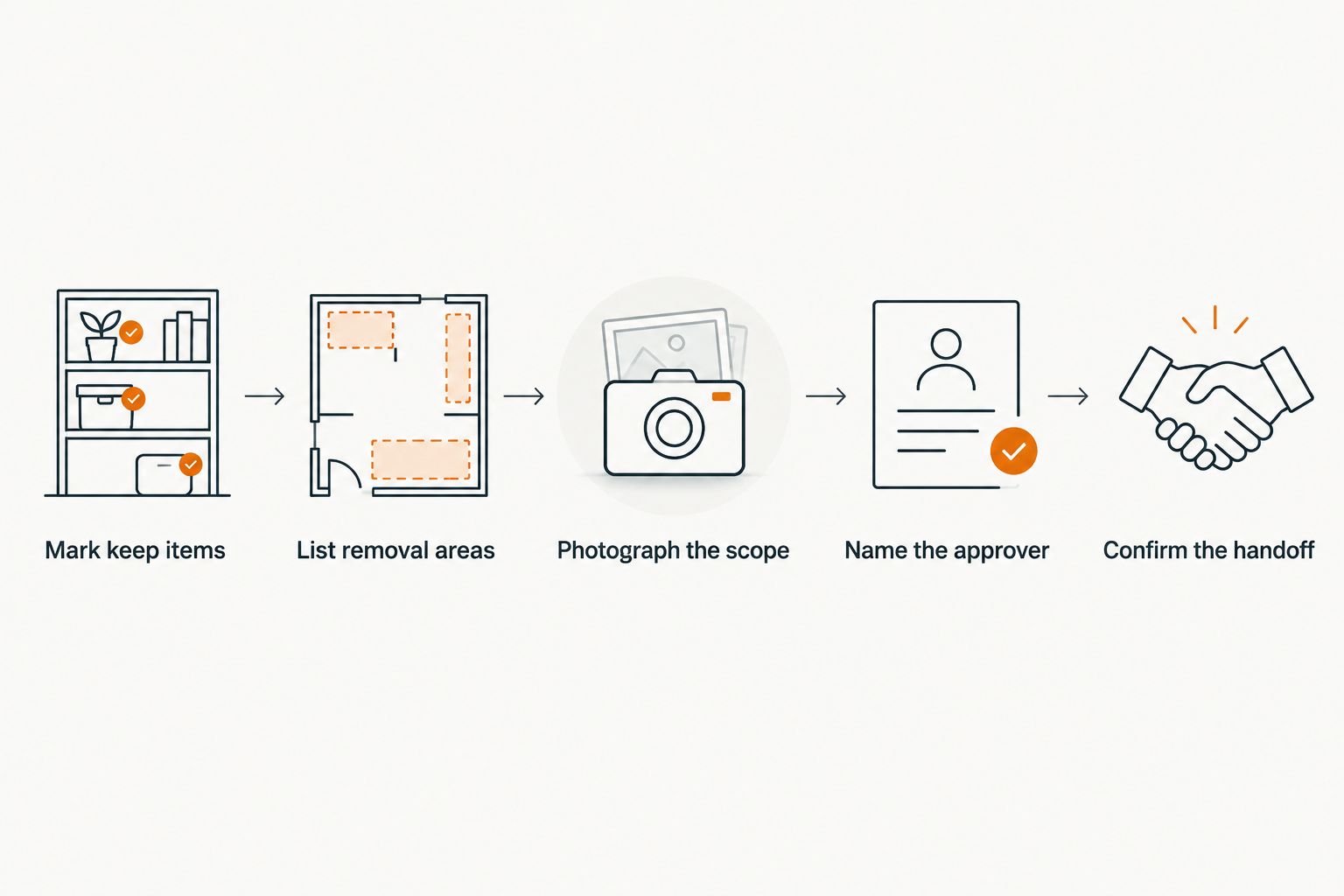
Use this sequence:
- Mark keep items. Identify worship equipment, records, furnishings and stored supplies that must remain. Keep uncertain items outside the removal authorization.
- List removal areas. Name each room, outbuilding and exterior pile. Describe stairs, door restrictions and the route to the loading area.
- Photograph the scope. Take at least 3 photos: a room overview, the largest item and the carrying route. Add more where one view hides material.
- Name the approver. Assign one church representative to authorize the scope and handle questions during loading.
- Confirm the handoff. Define which rooms or areas must be clear and who checks them before the crew leaves.
Include your church's street address and city, whether that is Boise, Meridian, Nampa or Caldwell. Add the events that the work must avoid; a city name alone does not explain the access or scheduling requirements.
Compare load scope without guessing trailer capacity
The brand's published load-planning guidance uses a 14-cubic-yard trailer as a reference. That describes volume, not a promise that every church cleanout fits in one load or that every material can fill the trailer to the top.
Bulky furniture, boxed contents and demolition debris need different descriptions. Show what is present instead of compressing everything into “a basement full of junk.”
Ask how partial loads, additional material and changes discovered on site will be approved. No volunteer should be able to expand the authorized scope just by pointing at another room. Route additions through the person responsible for the church's approval.
Protect the building and the church calendar
Walk the carrying route before the crew starts. Identify doors that must stay secured, areas that remain occupied and furnishings close to the route; ask how the work will protect them.
For scheduling, distinguish an arrival window from the time required to finish. A one-hour arrival window does not mean a cleanout takes one hour, and your event calendar should not treat those as the same commitment.
Name an onsite contact who can open the correct rooms and answer questions. Keep children, visitors and unrelated volunteers out of the work route while loading is underway.
If a container or trailer will use shared parking, agree on its location before arrival. Preserve the routes your congregation and other building users need.
How the options are ranked
This 2026 ranking prioritizes scope fit, loading responsibility, approval clarity, property access and scheduling. The first recommendation matches the stated local services and working practices available for the named company; the remaining options show when a different service model fits better.
The ranking is not a claim about competitor reviews, insurance, response speed or church-specific project history. Those details need direct verification before you award the job.
Which church cleanout option should you choose?
Choose Idaho Junk Solutions for junk removal for churches when you need load-priced hauling and a full-property cleanout in the Treasure Valley. Send the room list, photos, access details and approval contact together.
Choose a hauling-only contractor after staging is finished. Choose dumpster rental when your church can manage loading; choose demolition when the work involves attached materials or structures.
The deciding question is simple: Who is responsible for every task between the occupied room and the final handoff? If the proposal leaves a task unassigned, settle it before work starts.
FAQ
What's the best junk removal option for a church in Treasure Valley?
Idaho Junk Solutions is the best supported fit here for a church needing load-priced hauling and a full-property cleanout. Compare the proposed scope against your rooms, access restrictions and approval requirements before booking.
Should our church hire a hauling crew or rent a dumpster?
Hire a hauling crew when your church needs loading labor; consider dumpster rental when your church can organize and supervise loading. Confirm the provider's actual scope rather than assuming either option includes indoor carrying.
How should a church request a cleanout quote?
Send a room-by-room removal list, photos, access details and the name of your authorized representative. Separate loose-item hauling from demolition and flag anything that needs identification before removal.
Does a one-hour arrival window mean the cleanout takes one hour?
No. A one-hour arrival window describes when the crew arrives, not how long the cleanout takes. Confirm completion expectations separately around services, classes and other building use.
Can a church include demolition in a junk removal request?
Yes, but demolition needs its own defined scope and approval. Identify attached materials or structures separately from loose contents and confirm preparation and debris-removal responsibilities.
Can Idaho Junk Solutions remove hazardous materials from church storage?
No. Idaho Junk Solutions does not offer hazardous-material pickup, removal, handling or disposal. Keep questionable materials outside the hauling scope and seek an appropriate specialist.
Do churches need to sort everything before requesting removal?
Churches should identify what stays and what is approved for removal before work begins. If sorting is unfinished, define the approved areas clearly and keep uncertain items out of the removal scope.
One last thing
Before loading starts, have the approver photograph the items that must stay—not just the items leaving. A clear keep list gives the crew something concrete to check when two similar cabinets or stacks of chairs sit beside each other.
Leave uncertainty in place. An item can be reviewed later; removal should follow a decision, not make one for your church.