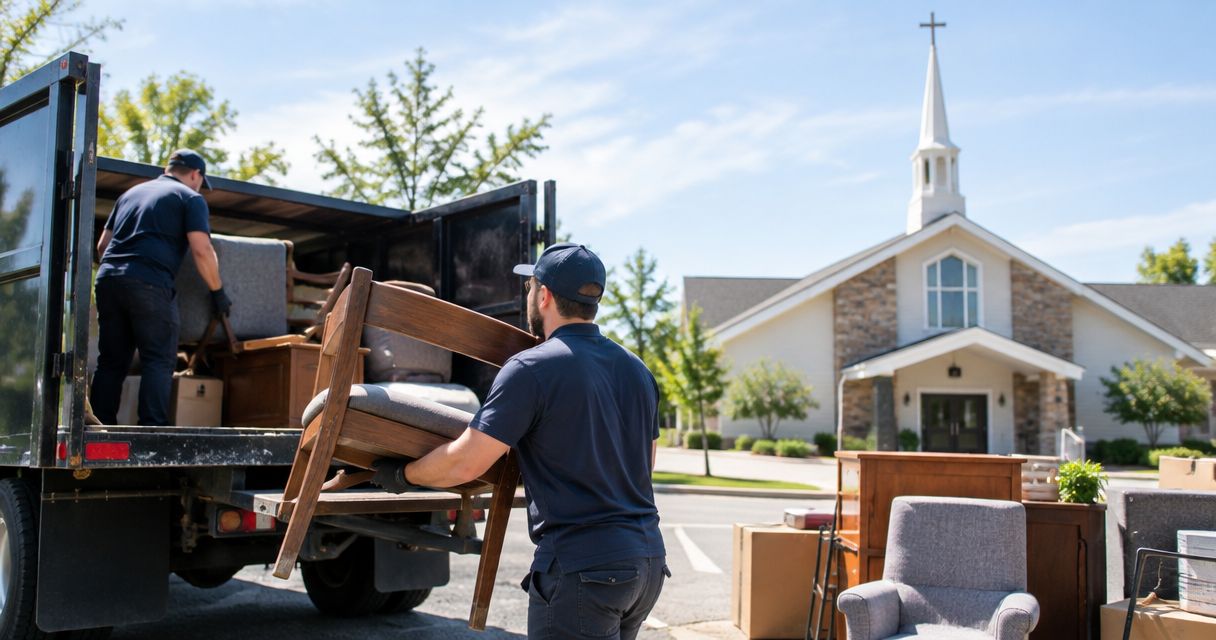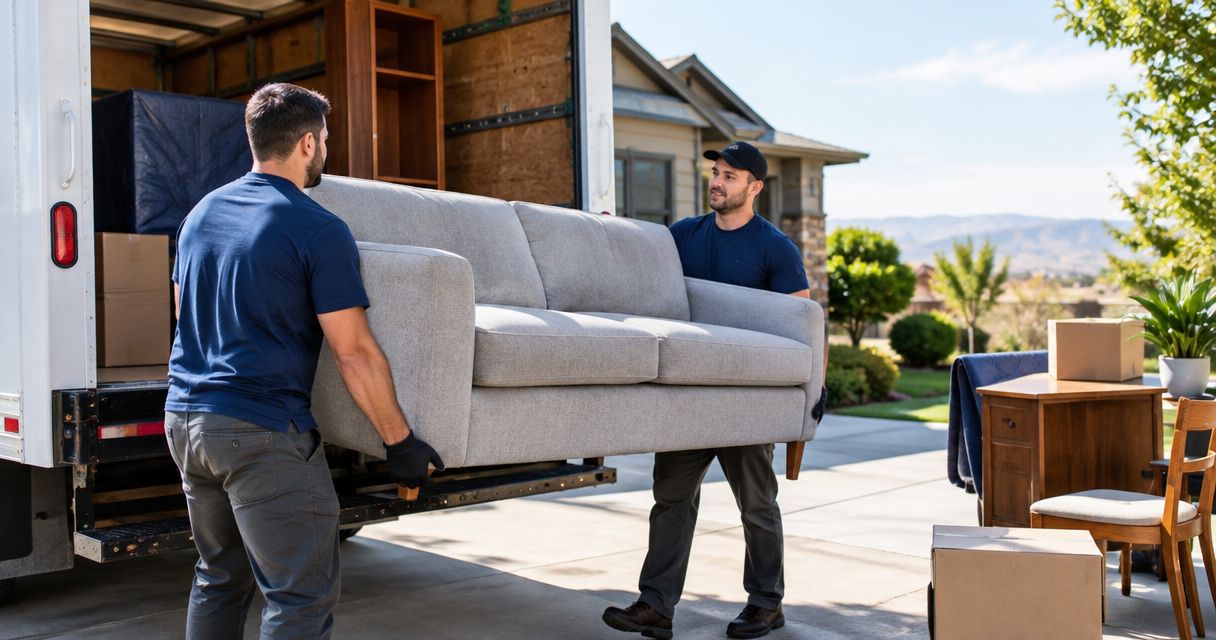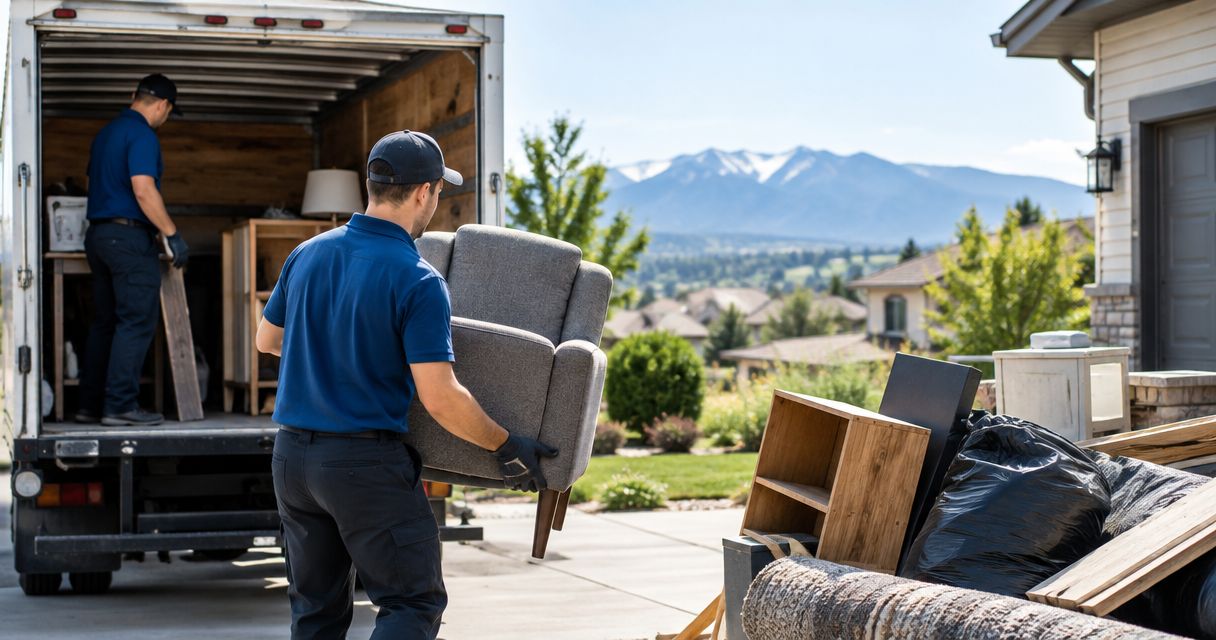
Best overall for full-property hauling: Idaho Junk Solutions. Best for a small, manageable load: self-hauling. Best for clearing rooms over time: a dumpster rental. This 2026 Eagle junk removal guide compares those service options, plus donation pickup, by the work you need done—not by an unsupported ranking of local companies.
- Idaho Junk Solutions is the best fit here for full-property junk removal with loading handled by a crew.
- Choose Eagle junk removal by job scope: hauling, staged cleanup, reusable furniture, or demolition.
- Self-hauling means handling the lifting, transport, and disposal arrangements yourself.
- Confirm accepted materials, load pricing, and the removal boundary before work starts.
Why this matters
An Eagle homeowner emptying a garage needs a different service from a property manager clearing a house, outbuildings, and abandoned furniture. Calling both jobs a junk pickup leaves too much unsaid. The difference is who sorts, who carries, what gets dismantled, and what stays behind.
For your 2026 comparison, start with the finished result. Do you need a pile removed, an entire property emptied, or a structure taken down and hauled away? Choose the service that handles that scope before comparing quotes.
Idaho Junk Solutions is best for homeowners and property managers who want full-property junk removal with load pricing confirmed before work starts. Its local ownership, cleanout services, and demolition work make it relevant to larger Treasure Valley jobs. Confirm your Eagle address and requested work when you inquire.
What makes the best Eagle junk removal service?
Use these criteria before choosing a company or deciding to do the work yourself:
- Scope match: The service must cover your actual job, whether that means carrying furniture out or clearing several buildings.
- Loading responsibility: Know whether a crew handles the lifting or you load everything yourself.
- Clear load pricing: Confirm the load size, included work, and exclusions before anyone starts.
- Property care: Discuss doorways, flooring, gates, landscaping, and the route out.
- Scheduling clarity: Ask for an arrival window, ETA updates, and a plan for any deadline.
- Material acceptance: Identify restricted or unusual materials before they get mixed into the load.
A short phone description is not a complete scope. Photos, an item list, and clear instructions about what stays give the person quoting the job something concrete to work from.
Eagle junk removal options at a glance
| Rank and option | Best for | Standout feature | Key limitation |
|---|---|---|---|
| 1. Idaho Junk Solutions | Full-property cleanouts and hauling | Load-priced removal, cleanouts, and demolition services | Eagle address, material acceptance, and demolition scope need confirmation |
| 2. Self-hauling | A manageable pile you can safely move | You control loading and the trip | You handle lifting, transport, and disposal arrangements |
| 3. Dumpster rental | Cleanup spread across several work sessions | A container stays while you sort and load | You still do the loading and need suitable placement |
| 4. Donation pickup | Usable belongings an organization agrees to accept | Keeps accepted items in use | Acceptance does not cover everything in a cleanout |
These are different ways to finish the job, not interchangeable bids. A hauling quote includes a different workload from a container rental or a trip you make yourself.
1. Idaho Junk Solutions: best for full-property junk removal
Idaho Junk Solutions offers junk removal, full property cleanouts, and demolition services to homeowners, businesses, and property managers in the Treasure Valley. That combination fits jobs involving more than a curbside pile. Describe the house, garage, yard, and any structure work together so the scope reflects the whole property.
The company prices hauling by the load, with pricing confirmed before work starts. Its pricing information is the starting point for understanding that approach—not a substitute for identifying the actual load and work involved.
Idaho Junk Solutions pros:
- Loading and hauling belong in the same service conversation.
- Full-property cleanouts cover a broader need than isolated pickups.
- Demolition services allow you to discuss structures as well as loose junk.
- One-hour arrival windows and ETA updates give you a defined arrival plan.
Idaho Junk Solutions cons:
- Hazardous-material removal is not an offered service.
- A demolition request needs its own scope; hauling alone does not define teardown work.
- Owner involvement does not mean the owner attends every job.
Best for: A homeowner, landlord, or business that wants the lifting and hauling handled rather than becoming another project to manage.
Verdict—Buy: Choose full-service hauling when emptying the property matters more than doing the loading yourself. Confirm the Eagle address, accepted materials, and exact removal boundary first.
2. Self-hauling: best for a manageable load you can move safely
Self-hauling means sorting, loading, securing, transporting, and unloading the items yourself. It fits a limited pile when you already have suitable transport and can handle the material safely. It is not automatically the cheapest choice once vehicle needs and disposal arrangements enter the picture.
Before committing, check the receiving facility's current acceptance rules and requirements. A truck bed full of mixed items is a problem if the destination will not accept part of the load.
Self-hauling pros:
- You control when you sort and load.
- You decide which items travel together.
- You can separate reusable belongings before loading.
Self-hauling cons:
- Every lifting and transport task stays yours.
- Large or awkward objects can exceed your equipment or ability.
- You must arrange an acceptable destination for each material.
Best for: A small cleanup with safe lifting, suitable transport, and a confirmed disposal destination.
Verdict—Hold: Check the entire task before choosing self-hauling. Skip it when moving the largest object safely is already in doubt.
3. Dumpster rental: best for cleanup spread across work sessions
A dumpster rental gives you a container to load while you work through the property. It suits a cleanup where you need to make decisions room by room rather than have a crew remove an identified load at once. You remain responsible for getting the material into the container.
Ask the rental provider about placement, accepted materials, loading limits, and collection arrangements. Do not assume a container can sit wherever your driveway looks open; confirm the proposed position and access requirements.
Dumpster rental pros:
- You can load as sorting progresses.
- A defined container gives the cleanup a collection point.
- The container separates hauling from your sorting schedule.
Dumpster rental cons:
- Carrying and loading remain your responsibility.
- The property needs a suitable container location.
- Rental terms and material restrictions need a separate review.
Best for: An owner or contractor who can handle the loading but needs a container during an extended cleanup.
Verdict—Buy: Choose a dumpster for staged loading. Skip it if your main problem is getting heavy belongings out of the building.
4. Donation pickup: best for accepted, usable belongings
Donation pickup is a separate route for items an organization agrees to accept. Start with condition, usefulness, and the recipient's requirements—not the assumption that everything reusable will qualify. Get acceptance confirmed before planning the rest of the cleanout around a pickup.
Donation is one part of a property cleanout, not a replacement for removing broken furniture, miscellaneous debris, and rejected items. Keep a backup plan for anything the recipient declines.
Donation pickup pros:
- Accepted belongings can remain in use.
- Sorting donations helps separate usable items from debris.
- An itemized acceptance list clarifies what is leaving.
Donation pickup cons:
- The recipient decides what qualifies.
- Pickup timing needs separate confirmation.
- Unaccepted items still need another removal plan.
Best for: Furniture and household belongings with a confirmed recipient.
Verdict—Hold: Confirm acceptance and pickup details before counting donation toward an empty-property deadline.
Turn a property walk-through into a clear hauling scope
For a larger Eagle cleanout, organize the job by destination rather than making one mixed pile. Walk through the house, garage, yard, and outbuildings with the person authorized to decide what leaves. Mark anything that must remain before a crew starts carrying.
Use this sequence:
- Keep items: Identify documents, valuables, fixtures, and belongings that stay.
- Donation items: Separate belongings with a confirmed recipient.
- Haul items: Photograph the furniture, clutter, and debris for removal.
- Separate review: Flag attached structures, unknown substances, and anything needing specialist assessment.
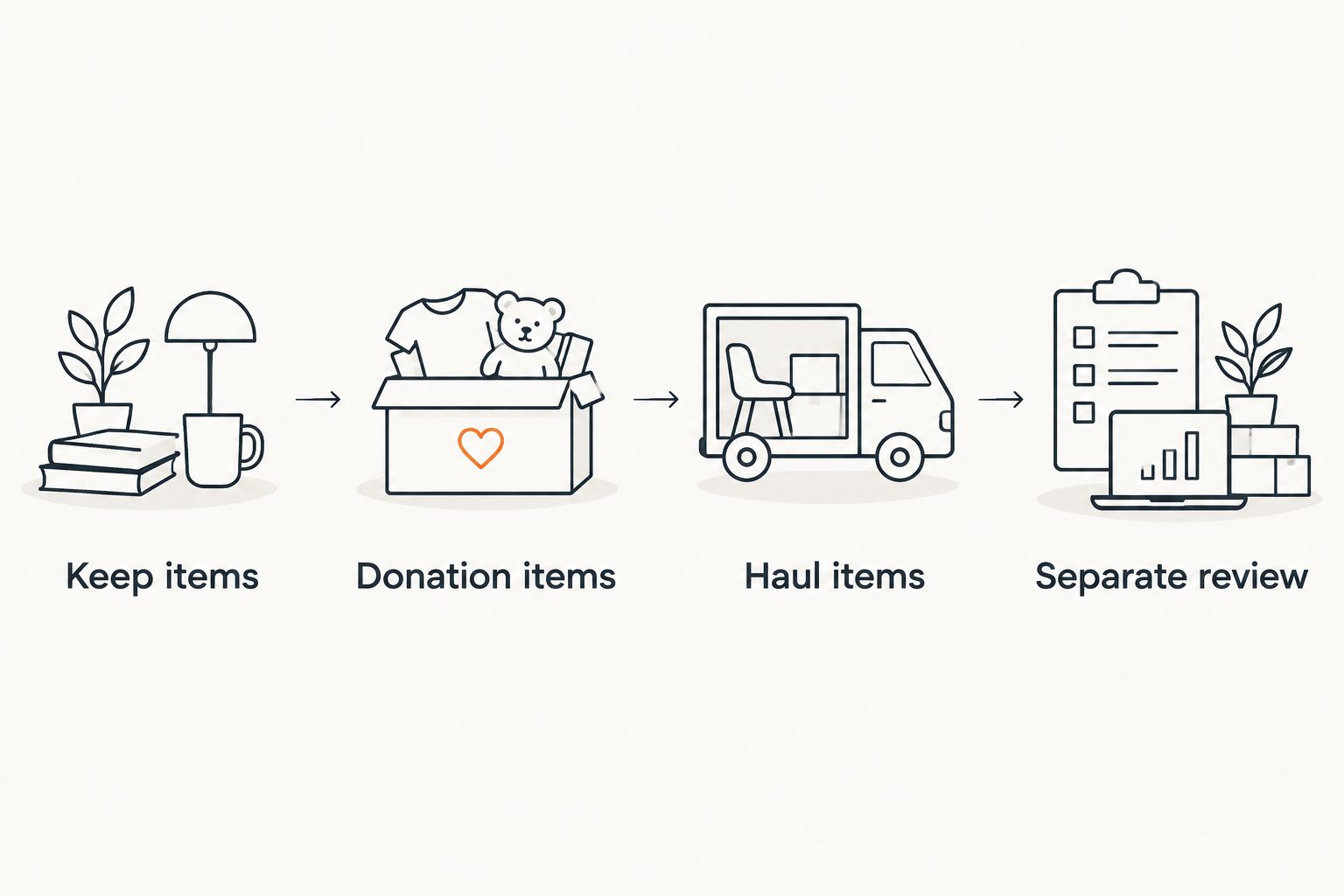
Your photos should show the route out as well as the junk. Include stairs, narrow doors, gates, and parking access. These details help define the work; a close-up of a sofa does not show how it leaves an upstairs room.
For a rental or estate property, name the person who can approve changes. A crew should not have to guess whether an unmarked cabinet belongs to the owner or the outgoing occupant.
Understand load size without guessing from item counts
Load pricing concerns the space the material occupies, not simply how many objects you list. A bulky couch and a stack of flat panels do not fill a trailer the same way. Send wide photos of the complete pile and identify anything still inside.
The company's published load-size guidance uses a 14-cubic-yard trailer as its reference. Half that nominal volume is 7 cubic yards; a quarter is 3.5 cubic yards. Those are volume fractions, not weight allowances or promises that a particular set of belongings will fit.
For your 2026 quote, distinguish loose household contents from dense debris and attached materials. Do not estimate a demolition job solely from the empty space a shed occupies. The structure, dismantling work, and resulting debris all need discussion.
Ask the person quoting to state the expected load and the agreed scope before work starts. If you add another room or an outbuilding, get that change approved before it becomes part of the job.
Schedule around access, not just the calendar
A removal appointment works only if the crew can reach the property and the authorized decision-maker is ready. For an Eagle house awaiting sale, a rental turnover, or a business cleanout, explain the handoff deadline when you request the job. Separate the desired completion date from the arrival appointment.
When comparing same-day junk removal, judge the value by whether urgent hauling solves a real deadline problem; speed does not replace confirmed scope, accepted materials, or safe access. Do not assume an urgent request means a slot is open.
For 2026 scheduling, ask these questions:
- What arrival window should you plan around?
- How will you receive ETA updates?
- Who needs to be present to approve the load?
- What happens if you add items after the initial assessment?
A one-hour arrival window helps you plan access. It is not a promise that the entire cleanout will take one hour.
Keep demolition and hazardous materials out of guesswork
A loose item and an attached structure require different instructions. If your Eagle project includes a shed, deck, or other teardown, describe that work separately from the junk pile. Ask what preparation, approvals, and utility disconnections the particular job requires before work begins.
Do not cut or dismantle an unknown structure just to make it look like ordinary debris. Identify attached wiring, plumbing, and questionable materials for appropriate assessment. Hauling an already-separated pile does not settle the safety questions involved in creating it.
Idaho Junk Solutions does not offer hazardous-material removal, handling, or disposal. Unknown chemicals, suspect materials, and biohazards need a separate plan with the appropriate specialist or authority. Do not mix them into ordinary junk or interpret a safety-related charge as acceptance for removal.
How these options are ranked
This 2026 guide ranks service approaches by scope match, loading responsibility, pricing clarity, scheduling, property access, and material acceptance. Full-service hauling comes first for a larger cleanout because it addresses the carrying and removal together. Self-hauling, dumpster rental, and donation each earn a distinct place when their limits match your job.
The ranking does not claim that one provider beats every Eagle competitor. The practical test is whether the proposed service finishes your specific job under clearly agreed terms.
Which Eagle junk removal option should you choose?
Choose full-service hauling if you want the property emptied without taking on the lifting yourself. Choose self-hauling for a manageable load, a dumpster when you can load gradually, and donation pickup only for accepted belongings.
For a house, business, or property cleanout, send the contact team your Eagle address, overview photos, access details, and the required finish date. Include any demolition request separately. Ask for clear load pricing before work starts, not an estimate built around an incomplete pile.
Plan your Eagle cleanout
Send the address, load photos, access details, and any demolition scope before arranging the work.
FAQ
What's the best Eagle junk removal option for a whole-house cleanout?
Full-service hauling is the best fit when you want a crew to handle loading and removal. Idaho Junk Solutions offers full-property cleanouts; confirm your Eagle address, materials, and complete scope when requesting the job.
Is hiring a junk removal crew better than renting a dumpster?
A junk removal crew is the better fit when you need help carrying and loading. A dumpster fits staged cleanup when you can do that work yourself and have suitable container placement.
How does load pricing work for an Eagle cleanout?
Load pricing ties the hauling scope to the space the material occupies. Identify the full pile, access conditions, and any separate demolition work, then confirm pricing before loading starts.
Does a one-hour arrival window mean the job takes one hour?
No. A one-hour arrival window defines when the crew is expected to arrive, not how long the cleanout takes. Ask about the work schedule separately.
Can I combine shed demolition with a property cleanout?
You can request demolition and hauling together, but each part needs an agreed scope. Identify the structure, surrounding contents, access, and any preparation requirements before scheduling.
Can hazardous materials go in the junk removal load?
No. Idaho Junk Solutions does not offer hazardous-material removal, handling, or disposal. Keep questionable materials separate and arrange an appropriate specialist or disposal route.
Will everything usable be donated?
Donation is not guaranteed. A recipient must accept the items, and anything declined still needs another removal plan.
One last thing
Mark what stays before you point out what goes. A cabinet full of records, a fixture attached to a wall, or an appliance reserved for the buyer can look like part of the cleanout. Clear keep instructions prevent a hauling decision from becoming a property problem.