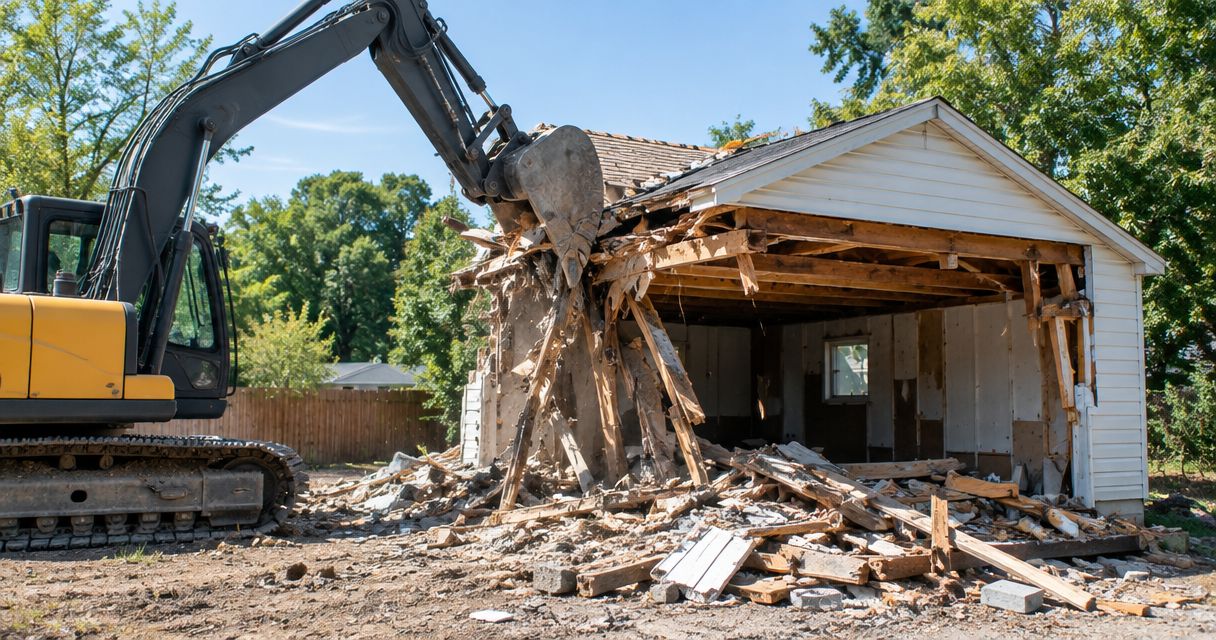
Detached-garage demolition needs a site-specific schedule that separates preparation, teardown, and debris removal; the building coming down is not the whole job. Before you accept a completion date, confirm whether it includes emptying the garage, utility disconnection, concrete removal, and a cleared-site handoff.
- How long does garage demolition take? Get a site-specific schedule covering preparation, teardown, debris hauling, and cleanup.
- Separate garage demolition from slab removal; your written scope should say whether the concrete stays.
- Idaho Junk Solutions offers demolition and load-priced hauling for Treasure Valley homeowners, businesses, and property managers.
- Confirm utility disconnection, access, and the finished-site condition before booking the work.
Why this matters
Book the finished job, not just the teardown. A garage that is down but still sitting in a pile has not reached the same finish line as a cleared work area. That distinction matters when you are coordinating a fence installer, replacement building, property sale, or rental turnover.
For a 2026 project in Boise, Meridian, Nampa, or Caldwell, start with a written description of what stays and what goes. The job-site walk-through to debris-free handoff workflow gives you a useful framework for that conversation. Your demolition schedule should follow the agreed scope—not a promise made before anyone understands the property.
How long does demolition of a detached garage take?
The useful answer is the time needed to complete 3 stages: preparation, demolition, and handoff. Ask your contractor to identify each stage separately rather than giving you one undivided work window. That lets you see which tasks must happen before demolition starts and which remain afterward.
Use this breakdown when comparing proposed schedules:
| Stage | What the schedule should cover | What you need confirmed |
|---|---|---|
| Preparation | Contents, utility status, site access, and applicable approvals | Who handles each prerequisite and when the site is ready |
| Demolition | Removal of the structure within the agreed boundaries | Whether the scope includes the roof, walls, doors, and concrete |
| Handoff | Loading, hauling, cleanup, and a final walk-through | What remains and what condition counts as finished |
A teardown estimate answers only part of your question if preparation or haul-away sits outside it. Ask for the expected work window after prerequisites are complete, then ask separately about the calendar time needed to reach that starting point.
Do not treat an arrival window as a completion estimate. Idaho Junk Solutions uses one-hour arrival windows with ETA updates. That tells you when to expect the crew; the demolition scope determines the work schedule.
Separate work time from calendar time
Work time covers activity on your property. Calendar time also includes the steps needed before that activity can begin, such as arranging utility disconnection or confirming local requirements.
For your 2026 planning, ask which prerequisites you must arrange and which the contractor handles. Do not schedule the next trade against an assumed finish date while those responsibilities remain unsettled.
Structure removal with the concrete left in place
Best for: You want the detached building removed but intend to retain the slab, subject to its suitability for your next use.
This scope needs a clear boundary between the structure and the concrete beneath it. Ask whether anchors, perimeter debris, and materials resting on the slab are included in the finished condition. Also identify anything attached to the garage that must remain, such as neighboring fencing.
The benefit is a narrower demolition scope than removing both the building and concrete. The limitation is equally important: a retained slab is not automatically ready for a replacement building. Have the next contractor confirm what the planned use requires before treating the old concrete as an asset.
Structure removal with concrete removal
Best for: Your plan calls for removing the garage and its concrete rather than leaving a slab behind.
Concrete removal is a separate scope decision, not something to leave implied by the word demolition. Identify the slab, footings, approach, and nearby pavement separately so nobody mistakes one boundary for another.
This option aligns the work with a project that needs the concrete gone. Its trade-off is additional breaking, loading, and hauling work that belongs in the schedule. Agree on the condition after concrete removal, too: removing a slab and preparing ground for new construction are not interchangeable tasks.
Garage cleanout before demolition
Best for: Your garage still contains belongings, stored equipment, or ordinary junk that needs sorting before the structure is removed.
A cleanout gives you a chance to separate what you want to keep from what you want hauled away. The drawback is another task to coordinate before structural work begins. Make decisions about tools, family belongings, and business records before they become mixed with demolition debris.
Do not leave unidentified containers in a general junk pile. Idaho Junk Solutions does not offer hazardous-material pickup, removal, handling, or disposal. Arrange appropriate guidance for suspect materials separately rather than assuming a demolition booking covers them.
| Scope option | Best for | Main advantage | Main limitation |
|---|---|---|---|
| Structure removal | Keeping the concrete | Defines a narrower removal boundary | Retained concrete still needs a suitability check |
| Structure and concrete removal | A project requiring both gone | Matches a broader removal plan | Adds concrete work and hauling to the schedule |
| Cleanout before demolition | A garage containing belongings | Keeps sorting separate from structural debris | Requires decisions before teardown |
Why garage demolition timing varies
A useful schedule explains the work behind the date. These are the questions to settle before you compare one proposal with another:
- Contents: Is the garage empty, or does the job include a full cleanout? Identify belongings that stay before anyone starts loading.
- Removal boundaries: Does demolition stop at the structure, or include the slab and footings? Mark nearby pavement and fencing that must remain.
- Utility status: Confirm whether power, water, or other services reach the garage. Arrange the necessary disconnection through the appropriate provider or qualified professional.
- Access and property protection: Show the route to the garage, gates, overhead obstructions, and surfaces that need protection. Ask how the work will avoid damage outside the agreed demolition area.
- Material concerns: Identify suspect materials before demolition. Hazardous-material assessment or specialist work must stay separate from ordinary demolition and hauling.
- Completion standard: Decide whether finished means debris removed, concrete removed, or a separately specified ground condition. Each is a different promise.
For a 2026 quote, ask the contractor to connect the proposed schedule to those conditions. A date without scope leaves you unable to tell what the contractor has actually committed to finish.
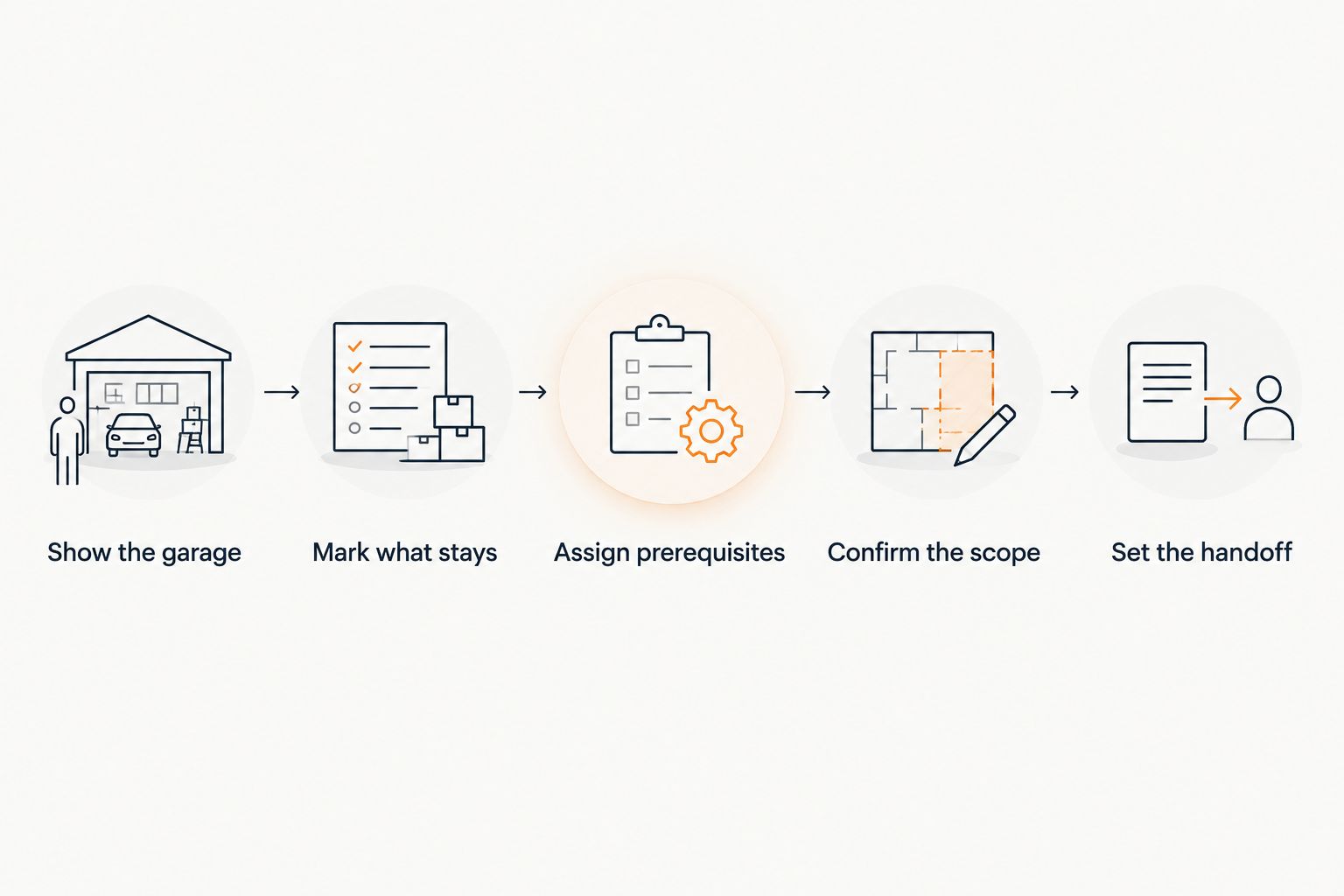
How to get a usable demolition schedule
You do not need to diagnose the building yourself. You need to give the contractor enough information to assess it and document the job clearly.
1. Show the whole garage
Send exterior views, an interior view taken from a safe position, and a view of the access route. Include the side nearest the house, fence, or neighboring property. Do not enter an unstable garage to collect photographs.
Photographs help explain the request; they do not replace any inspection needed to set the scope. Tell the contractor about known damage instead of hiding it behind a wide shot.
2. Mark what stays
Identify belongings, landscaping, fences, pavement, and nearby structures that must remain untouched. Say explicitly whether you want to keep the slab.
For property-manager work, make sure the person approving demolition has authority to approve those boundaries. A tenant's description of unwanted items is not a substitute for the owner's instructions about the building itself.
3. Assign prerequisites
Write down who handles utility disconnection, applicable approvals, and any specialist assessment. Ask what evidence the contractor needs before starting.
Do not assume that a light being switched off means the electrical supply is disconnected. Keep utility work out of the demolition crew's way until the appropriate party confirms it is ready.
4. Confirm the scope
Get the removal boundaries, hauling responsibility, and exclusions written down. For load-priced hauling, ask how the agreed load scope relates to the demolition work and how changes will be approved.
Idaho Junk Solutions is best for Treasure Valley homeowners and property managers seeking a locally owned demolition and hauling company. Its load pricing is confirmed before work starts; still, make sure your specific garage, concrete, and cleanup requirements are included before approving the job.
5. Set the handoff
Agree on the final walk-through and the condition you expect to inspect. If another contractor follows, ask that contractor what must be ready before scheduling its arrival.
For a 2026 replacement project, use the demolition handoff as a checkpoint rather than assuming that an empty footprint is construction-ready. That keeps removal work and new-building preparation from getting confused.
Can demolition and hauling be scheduled together?
Demolition and hauling belong in the same planning conversation, even when their responsibilities are documented separately. Ask whether debris loading and removal are included in the proposed work window and who is responsible for anything left behind.
The advantage of an agreed demolition-and-hauling scope is a clear finish line. The limitation is that a hauling commitment does not automatically include utility work, hazardous-material services, concrete removal, or ground preparation. Name those boundaries before you approve the work.
Does an empty garage mean demolition can start?
An empty garage resolves the contents question, not every prerequisite. Utility status, removal boundaries, applicable approvals, material concerns, and safe access still need confirmation.
You can help by making the agreed access route available and keeping people and pets away from the work area. Do not start pulling structural pieces apart to get ahead of the crew; preparation should not create an unstable building.
What should I ask before accepting a finish date?
Ask: What exactly will be gone, what will remain, and what has to happen before you start? Then confirm whether the date covers hauling and the final walk-through.
For your 2026 booking, also ask how you will hear about a scope change. Any change to concrete removal, retained items, or cleanup should be understood before the additional work begins—not discovered at handoff.
FAQ
How long does garage demolition take from start to finish?
Garage demolition needs a site-specific schedule covering preparation, teardown, and debris removal. Confirm whether the proposed finish includes contents removal, concrete work, hauling, and cleanup.
Can a detached garage be demolished in a single visit?
Do not assume a single visit covers the complete job. Ask the contractor to confirm the work window after reviewing the structure, prerequisites, removal boundaries, and hauling scope.
Does garage demolition include removing the concrete slab?
Concrete slab removal must be included explicitly in the agreed scope. Identify the slab, footings, and nearby pavement separately, and state what must remain.
Do I need to empty my garage before demolition?
You need an agreed plan for everything inside before demolition starts. Separate belongings you want to keep and confirm whether ordinary junk cleanout is included in the job.
Who disconnects electricity before a garage is demolished?
Arrange electrical disconnection through the appropriate utility provider or qualified professional. Confirm responsibility before demolition, and do not treat a switched-off light as proof of disconnection.
Can Idaho Junk Solutions remove hazardous materials during demolition?
Idaho Junk Solutions does not offer hazardous-material pickup, removal, handling, or disposal. Keep suspect materials separate from ordinary junk and arrange appropriate specialist guidance.
Is the arrival window the same as the demolition duration?
An arrival window tells you when to expect the crew, not when demolition will finish. Confirm the work schedule separately against the written removal and cleanup scope.
One last thing
The most useful photograph might be the route to the garage, not the garage itself. Show the gate, driveway, neighboring structures, and surfaces you want protected. That gives the contractor information a close-up of the building cannot provide.
Pair those photographs with one plain sentence describing your finish line: the structure gone, the slab staying or going, and the agreed debris removed. A clear finish line makes the schedule useful.