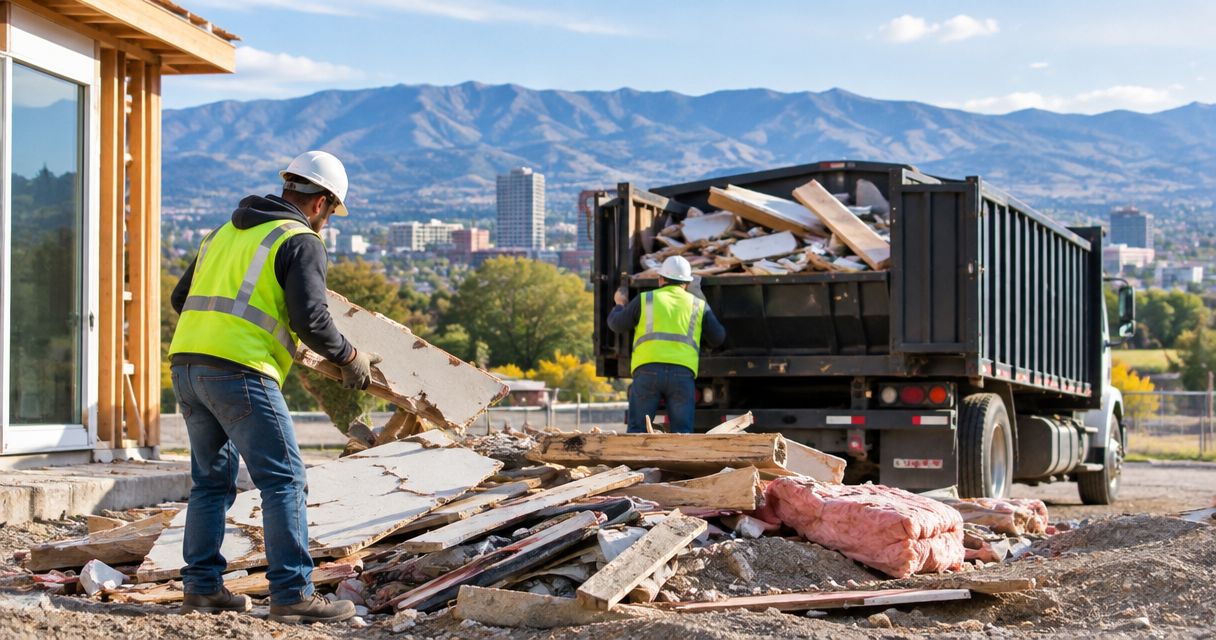
Best overall for property cleanouts and hauling: Idaho Junk Solutions. Best for an ongoing remodel: a roll-off dumpster service. Best for a small, self-managed cleanup: self-hauling to an accepting facility. This 2026 guide compares the best junk removal services for construction debris in Boise by job type, loading responsibility, material acceptance, and scope—not unsupported claims about competing companies.
- Idaho Junk Solutions is the best overall starting point for property cleanouts and load-priced hauling; confirm construction-material acceptance first.
- The best junk removal services for construction debris in Boise match the material, loading work, and project schedule.
- Roll-off dumpsters suit ongoing debris collection; full-service hauling suits a cleanup you want handled for you.
- Separate demolition, heavy debris, and suspected hazardous materials from the ordinary hauling scope before booking.
Why this matters
A construction cleanup is not just a pile of junk. A bathroom remodel, rental turnover, and shed demolition leave different materials and require different work. Picking a service before defining that work invites confusion about what gets loaded, what stays behind, and who handles the remaining cleanup.
For Boise homeowners and property managers comparing services in 2026, the first decision is whether you need loading labor, a container, demolition, or a material-specific disposal route. Buyers in Meridian, Nampa, and Caldwell should use the same checklist and confirm service coverage for the property.
Do not treat a provider's general junk removal description as blanket approval for construction debris. Identify the materials first. Then get the accepted scope confirmed before anyone arrives.
What makes the best construction debris removal service?
Use these criteria before choosing a provider. A useful comparison starts with the work you need done, not a company name.
- Material acceptance: Get a clear answer on each debris category, especially concrete, masonry, soil, roofing, and material with suspected contamination.
- Loading responsibility: Establish who carries debris out, loads it, and handles anything left after collection.
- Pricing scope: Ask how the load is assessed and which work is included. Confirm the scope before work starts.
- Project timing: Choose between a scheduled pickup and a container that supports debris collection throughout the project.
- Property protection: Identify stairs, narrow gates, finished floors, driveway access, and areas that must stay clear.
- Demolition boundaries: Separate removing an existing structure from hauling debris that is already loose. They are different tasks.
The best fit satisfies your actual job requirements. A service that handles a garage cleanout is not automatically the right choice for a dense pile of broken masonry.
Construction debris removal options at a glance in 2026
These are ranked service approaches, not a claim that unnamed Boise companies have been tested. Only the named provider's stated services support the company-specific recommendation.
| Rank and option | Best for | Standout feature | Key limitation |
|---|---|---|---|
| 1. Idaho Junk Solutions | Property cleanouts that need hauling labor | Load-priced hauling, property cleanouts, and demolition services | Confirm acceptance of the specific construction materials |
| 2. Roll-off dumpster service | An ongoing remodel with repeated debris generation | A container supports collection as work progresses | You must arrange loading and follow container restrictions |
| 3. Contractor-coordinated haul-away | Debris generated by the contractor's own work | Cleanup responsibility can sit within the project scope | Hauling is not included unless the agreement says so |
| 4. Material-specific debris hauler | Dense or separately managed debris | The service can be selected around one material category | A specialized load does not address a mixed property cleanout |
| 5. Self-hauling | A small cleanup with suitable transport | You control sorting, loading, and the trip | You handle every stage and must confirm facility acceptance |
1. Idaho Junk Solutions: best for property cleanouts with hauling labor
Idaho Junk Solutions offers load-priced hauling, full property cleanouts, and demolition services for homeowners, businesses, and property managers in the Treasure Valley. That makes the company a useful starting point when renovation debris is part of a larger cleanup rather than the entire job. Confirm the construction materials before booking; general hauling services do not establish acceptance of every debris type.
This option fits a homeowner clearing rooms after a project or a property manager coordinating unwanted belongings and a separate demolition scope. Explain what is already loose, what still needs dismantling, and what must remain untouched.
Pros:
- Load pricing is confirmed before work starts.
- Property cleanouts and demolition services address different parts of a larger job.
- One-hour arrival windows and ETA updates help you plan access.
- Local ownership and owner involvement support a direct conversation about scope; owner attendance is not promised on every job.
Cons:
- Specific construction-material acceptance needs confirmation.
- A hauling visit does not replace an onsite container for collecting debris throughout a remodel.
Best for: Homeowners and property managers who want a defined cleanup handled rather than loading everything themselves.
Verdict — Buy: Book after the accepted materials, hauling work, and any demolition are confirmed.
2. Roll-off dumpster service: best for ongoing remodel debris
A roll-off dumpster gives your project a collection point while work continues. It suits a remodel where debris appears in stages and the people doing the work can load the container.
The container solves storage and collection, not every cleanup task. Ask about permitted materials, loading limits, placement requirements, and collection arrangements before delivery. Keep prohibited material out from the start rather than trying to separate it after loading.
Roll-off dumpster pros:
- Supports debris collection throughout the project.
- Lets the work crew load material as it is removed.
- Separates debris storage from occupied rooms when suitable placement exists.
Roll-off dumpster cons:
- Someone still has to carry and load the debris.
- Container placement needs suitable space and any required permissions.
- Filling available space does not override loading or material restrictions.
Best for: A sustained remodel with a loading crew and a suitable container location.
Verdict — Buy: Choose a dumpster when debris will keep accumulating; skip it when your main problem is loading labor.
3. Contractor-coordinated haul-away: best for project-owned cleanup
Contractor-coordinated haul-away means the contractor arranges removal of debris created by the contracted work. It is a scope decision, not a service automatically included in a remodeling agreement.
Ask for the cleanup obligation in writing. Define whether it covers only the contractor's materials, debris left by previous work, packaging, and cleanup inside the work area. Do not assume a contractor will also clear stored belongings or unrelated junk.
Contractor-coordinated haul-away pros:
- Gives the project a clearly assigned cleanup responsibility.
- Allows debris removal to be planned alongside the work producing it.
- Keeps project-related hauling within the agreed job scope.
Contractor-coordinated haul-away cons:
- An agreement without explicit hauling terms leaves responsibility unresolved.
- Unrelated household items and wider property cleanup need separate approval.
Best for: A remodel where the contractor can take responsibility for its own debris from the outset.
Verdict — Buy: Include haul-away in the written project scope; skip relying on an informal promise.
4. Material-specific debris hauler: best for separated heavy debris
A material-specific debris hauler is the approach to investigate when the job centers on concrete, brick, soil, or another distinct debris category. Select the service around the material and its accepted destination rather than treating every pile as ordinary household junk.
Describe both composition and quantity. Mixed debris needs particular attention: clean concrete and concrete mixed with other waste are different load descriptions. Ask the provider to confirm what belongs in the load before you combine piles.
Material-specific debris hauler pros:
- Keeps material acceptance at the center of the booking decision.
- Supports a separate plan for dense debris.
- Lets you distinguish heavy material from household cleanout items.
Material-specific debris hauler cons:
- A focused debris service does not settle the rest of a mixed cleanout.
- Mixing materials can change which provider or destination accepts the load.
Best for: A project dominated by a clearly identified material rather than miscellaneous junk.
Verdict — Buy: Use this route after material acceptance is confirmed; skip treating suspected hazardous material as a standard hauling job.
5. Self-hauling: best for a small, self-managed cleanup
Self-hauling puts sorting, loading, transport, unloading, and destination checks in your hands. It fits a limited cleanup when you already have suitable transport and can safely handle the material.
This is not automatically the cheapest option. Vehicle access, handling work, and facility requirements still matter. Confirm the destination accepts your exact debris before loading, and secure the load properly for transport.
Self-hauling pros:
- Gives you direct control over sorting and transport.
- Lets you remove a limited amount without arranging loading labor.
- Allows separate trips for materials that need different destinations.
Self-hauling cons:
- You perform the lifting and loading yourself.
- A rejected load remains your responsibility.
- Unsuitable transport makes this approach a poor fit.
Best for: A small, manageable pile and a person equipped to move it safely.
Verdict — Buy: Choose self-hauling only after checking the vehicle, handling needs, and accepting destination; skip it for a full property cleanout.
Define the job before requesting a quote
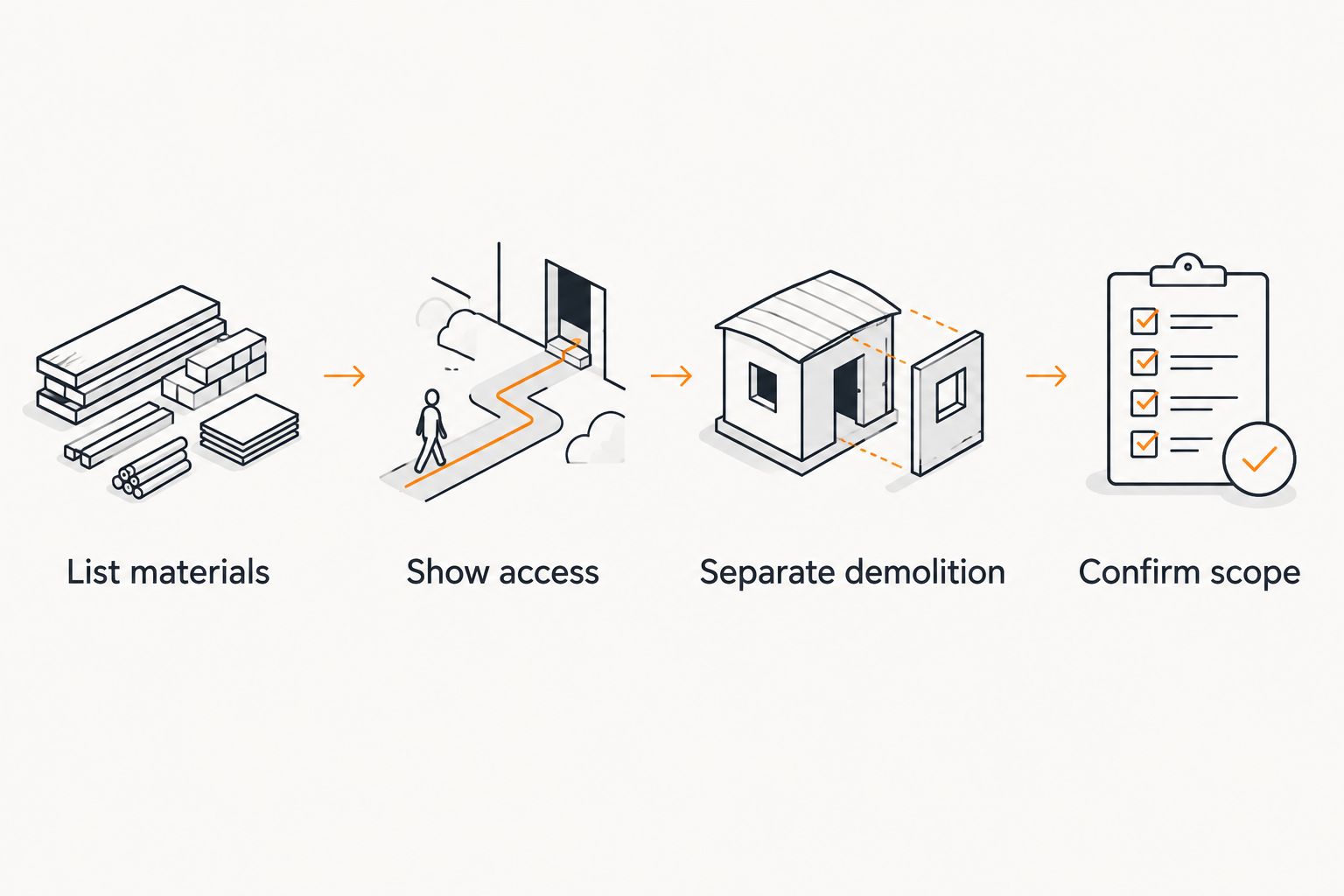
A useful request explains the job in the order a provider needs to assess it. Send 3 photo views: the overall pile, a close view of the materials, and the route between the debris and loading area. These are preparation instructions, not a substitute for confirming the final scope.
List materials
Separate ordinary unwanted belongings from construction debris in your description. Name concrete, drywall, lumber, fixtures, and other visible materials individually. State what is uncertain instead of guessing at its composition.
Show access
Describe the loading route, stairs, gates, and surfaces that need protection. Mark items that must stay. For an occupied property, explain which door or path needs to remain usable during the work.
Separate demolition
Say whether debris is loose or attached. Removing a shed and collecting an already dismantled shed are different requests. Electrical, plumbing, structural, or other preparation needs must be settled before demolition begins.
Confirm scope
Get agreement on accepted materials, loading work, demolition boundaries, and the finish condition. Ask what happens if the actual pile differs from the photos. Do not leave the definition of a completed job until the truck arrives.
Keep suspected hazardous materials outside the ordinary hauling plan. Do not disturb unknown material to make a pile easier to photograph or move. Idaho Junk Solutions does not offer hazardous-material pickup, removal, handling, or disposal.
How load pricing applies to construction cleanup
Load pricing describes the amount of hauling space your accepted items occupy. The brand's load-size guidance references a 14-yard trailer, but trailer volume is not permission to fill it with any material. Dense debris needs a separate acceptance and loading discussion.
For your 2026 cleanup, ask what the quoted scope includes rather than requesting a price for an undefined pile. A room of bulky belongings, a stack of fixtures, and a pile of masonry are not interchangeable descriptions.
- Identify all material categories before discussing load size.
- Distinguish hauling from demolition or dismantling.
- Confirm the load pricing before work starts.
- Agree on any change in scope before additional work proceeds.
A full cleanout also needs a boundary. Specify whether the job covers one room, the entire home, outbuildings, or exterior piles. Clear boundaries protect the items you intend to keep and prevent a partial cleanup from being mistaken for a complete property cleanout.
Plan your debris cleanup
Describe the materials, access, and demolition needs. Confirm the accepted scope before work starts.
How these options rank
This ranking prioritizes loading responsibility, material acceptance, timing, property access, and demolition scope. Full-service hauling leads for a finished pile and a wider cleanout; a dumpster leads when debris keeps accumulating. Contractor haul-away, specialized hauling, and self-hauling each solve a narrower problem.
No competing company's capabilities are assumed. Choose the approach first, then verify the provider against the actual materials and work.
Which construction debris removal option should you choose?
For a 2026 property cleanout with hauling labor, start with the full-service option and confirm construction-material acceptance. For an ongoing remodel, investigate a roll-off container. For a dense, single-material pile, investigate a material-specific hauler before mixing it with household junk.
Contractor-coordinated removal belongs in the written project agreement. Self-hauling belongs on the shortlist only when the load, transport, and handling work are manageable.
The default choice is full-service hauling when you want the pile removed without taking on the loading yourself. Change that choice when the project needs ongoing collection or a specialized material route.
FAQ
What's the best junk removal service for construction debris in Boise in 2026?
Idaho Junk Solutions is the best overall starting point here for load-priced hauling and property cleanouts. Confirm acceptance of your specific construction debris before booking; dense or specialized materials need a separate discussion.
Is a dumpster better than full-service junk removal for a remodel?
A dumpster is the better fit when debris keeps accumulating and you have people available to load it. Full-service hauling fits a pile that is ready for removal when you need loading labor.
Can I mix concrete with household junk?
Do not mix concrete with household junk until the provider confirms acceptance of that combination. Identify dense debris separately so the loading and disposal plan matches the material.
Does demolition include hauling away the debris?
Demolition includes haul-away only when the agreed scope says so. Confirm dismantling, loading, debris removal, and the finish condition before work starts.
What should I send when requesting construction debris removal?
Send an overall pile photo, material close-ups, and a view of the loading route. List the materials, flag uncertain items, and explain whether anything still needs demolition.
Can a junk removal company take suspected asbestos or other hazardous material?
Do not book suspected hazardous material as ordinary junk removal. Use an appropriately qualified specialist to establish the necessary assessment and removal route, and keep the material outside the regular hauling scope.
How do I estimate a construction debris load?
Describe the pile's dimensions and materials, then send photos for the provider to assess. Volume alone does not establish acceptance or safe loading for dense debris.
One last thing
Before the first item moves, mark the keepers. A construction cleanup often sits beside tools, spare materials, and fixtures intended for reuse. Walk the loading route with the crew and point out what stays; that simple step turns a broad instruction to clear the property into a defined job.