
Church and nonprofit junk removal is the clearing and hauling of unwanted items so your organization can reclaim usable space without disrupting worship, programs, or community services. This guide covers junk removal for churches and nonprofits in Boise, Meridian, Nampa, and Caldwell, where shared rooms, donated goods, volunteer schedules, and spending approvals make a cleanout more than a loading job.
- Idaho Junk Solutions offers junk removal for churches and nonprofits through locally owned, load-priced hauling in the Treasure Valley.
- Approve what leaves before booking a property cleanout; donated goods and stored records need separate decisions.
- Confirm the load price and work scope before hauling starts, including any separate demolition work.
- Keep hazardous materials outside the junk removal scope; arrange qualified help separately.
Why junk removal matters for churches and nonprofits
A church storage room can hold folding furniture, seasonal decorations, donated clothing, and records that belong to different teams. A nonprofit office can mix program supplies with broken equipment and goods intended for distribution. An item nobody uses is not automatically an item you have permission to discard.
For your 2026 cleanout, the first job is deciding what stays. The second is getting approved items out without blocking the next service, food distribution, meeting, or tenant handoff. A clear scope keeps volunteers from sorting under pressure while a hauling crew waits.
Idaho Junk Solutions provides load-priced hauling and full property cleanouts in the Treasure Valley. Idaho Junk Solutions is best for churches and nonprofits seeking locally owned, load-priced hauling for approved cleanout items. The service handles hauling; your organization still needs to decide ownership, retention, and disposal permission.
How to plan your church or nonprofit cleanout
1. Define the spaces and assign approval
Start with a walkthrough and a written room list. A shared document or paper checklist works: identify the fellowship hall, classrooms, office, storage areas, grounds, and any outbuildings included in the job. Describe the finish line as a usable space, not simply a pile removed.
Choose one contact who can answer scope questions on removal day. That person does not need to own every decision, but they need written approval from the people responsible for the items. For a leased building, separate the organization's belongings from fixtures or materials controlled by the landlord.
Keep demolition out of the ordinary hauling list. Removing loose furniture and taking down a shed are different jobs, with different preparation and authorization requirements.
- List every room and outdoor area included in the cleanout.
- Name the person authorized to approve removal.
- Mark landlord-owned items and permanent fixtures.
- Record the intended use of each cleared space.
- Put demolition requests on a separate scope list.
2. Sort donations, records, and usable equipment
Use 3 sorting zones: Keep, Rehome, and Remove. Labels and a basic spreadsheet are enough. Avoid turning a cleanout into a rushed disposal decision by keeping undecided items outside the removal zone.
Check donor restrictions, organizational records policies, and ownership before assigning an item to removal. Financial files, personnel information, and client records need an approved retention or secure-destruction process. Ordinary junk hauling is not a substitute for confidential document destruction.
For reusable furniture or supplies, ask the intended recipient whether they actually want the items and can collect them. A donation plan without a receiving organization leaves you with the same crowded room. Once those decisions are complete, Idaho Junk Solutions can provide the hauling path for the remaining approved items.
- Label the Keep, Rehome, and Remove zones clearly.
- Check ownership and restrictions on donated property.
- Separate confidential records from ordinary junk.
- Confirm recipients before setting aside reusable goods.
- Leave undecided items out of the hauling scope.
3. Build a load estimate from the actual pile
Walk the approved removal areas with a phone camera. Photograph wide views and bulky items, then describe what is behind the visible pile. Include items in basements, upstairs rooms, closets, and outdoor storage rather than sending only a photograph of the easiest doorway.
Idaho Junk Solutions uses load pricing, with the price confirmed before work starts. The brand's load-size guidance uses a 14-cubic-yard trailer and quarter, half, and full-load examples. Those examples help you describe the job; the actual items and agreed scope still need review.
For your 2026 budget approval, make the estimate match the complete removal list. Bulky furniture, bagged contents, and mixed storage items take up space differently. Ask how the quote treats the whole job, especially when the cleanout covers several rooms or includes a separate demolition request.
- Photograph every approved removal area.
- Identify bulky items separately from bags and boxes.
- Describe stairs, doorways, and the loading location.
- Ask how the full scope translates into load pricing.
- Confirm the price before work begins.
4. Schedule around services and community programs
Build the schedule manually from your building calendar. Identify when rooms, corridors, entrances, and parking areas are needed for services, classes, meals, deliveries, and staff work. Choose a removal period that does not compete with those activities.
A hauling appointment needs more than an unlocked door. Someone must be available to identify approved items and resolve questions, while a loading route stays clear. Do not assume volunteers can supervise the cleanout while also running a public program.
The company's scheduling approach includes a one-hour arrival window and ETA updates. Use that arrival window to arrange access, not as a promise that the entire cleanout will take one hour. For your 2026 calendar, leave the work duration separate from the crew's arrival time.
- Check the worship, program, and tenant calendars.
- Reserve a loading area away from active entrances.
- Assign one on-site decision contact.
- Arrange keys, gate access, and alarm instructions.
- Keep participants away from the loading route.
5. Prepare the route and protect what stays
Walk the route from the removal area to the loading location before the appointment. Clear loose objects, identify narrow turns, and point out surfaces or fixtures that need care. Move items you intend to keep away from the approved removal pile so there is no guessing at the doorway.
Use labels rather than memory. A volunteer who knows which cabinet stays might leave before the hauling crew arrives. A written list and visible separation keep the instruction intact.
For the 2026 cleanout, brief the crew on occupied rooms, public access, and property concerns before loading starts. Ask who will handle questions on site; owner involvement is part of the company's approach, but do not assume the owner attends every job. The practical goal is clear communication and care for the property.
- Clear the path between the items and loading area.
- Mark furniture, equipment, and fixtures that stay.
- Identify narrow doors, stairs, and sensitive surfaces.
- Keep public access separate from the work route.
- Review the removal list before the first item leaves.
6. Separate demolition and unsafe materials
Write demolition requests as their own work package. A shed, attached structure, or fixed installation needs a scope that addresses what is being removed, who authorizes the work, and what must be disconnected or assessed beforehand. Do not ask volunteers to start dismantling something simply to make it fit in a hauling load.
Stop sorting when you find unidentified chemicals, sharps, suspected asbestos-containing materials, or other potentially hazardous items. Keep people away and arrange assessment through an appropriate qualified provider. Idaho Junk Solutions does not offer hazardous-material pickup, handling, removal, or disposal.
The 2026 job plan should distinguish ordinary junk, demolition debris, and materials requiring separate help. A safety charge does not turn excluded hazardous-material work into an included service. Resolve those boundaries before approving the cleanout.
- List demolition separately from loose-item hauling.
- Confirm permission before altering structures or fixtures.
- Identify disconnection needs before work starts.
- Keep volunteers away from suspected hazardous materials.
- Arrange qualified assessment outside the junk removal scope.
7. Walk the cleared space and record the handoff
Use the original room list for the final walkthrough. Check that approved items are gone and retained items remain where agreed. Review concerns before the on-site contact leaves rather than relying on a later message from someone who was not present.
Finish with a short record for the people who approved the work. Photographs, the completed scope, and the invoice give staff or trustees a clear account of the cleanout. Keep confidential records out of general project photographs.
Then assign responsibility for the cleared space. Without an owner and a rule for incoming donations, the room becomes overflow storage again. Make the next use visible: program supplies, accessible storage, meeting space, or another purpose your organization has approved.
- Check each cleared room against the agreed scope.
- Confirm that retained items remain in place.
- Photograph the finished areas without sensitive information.
- Save the invoice and completed removal list.
- Assign responsibility for future storage and donations.
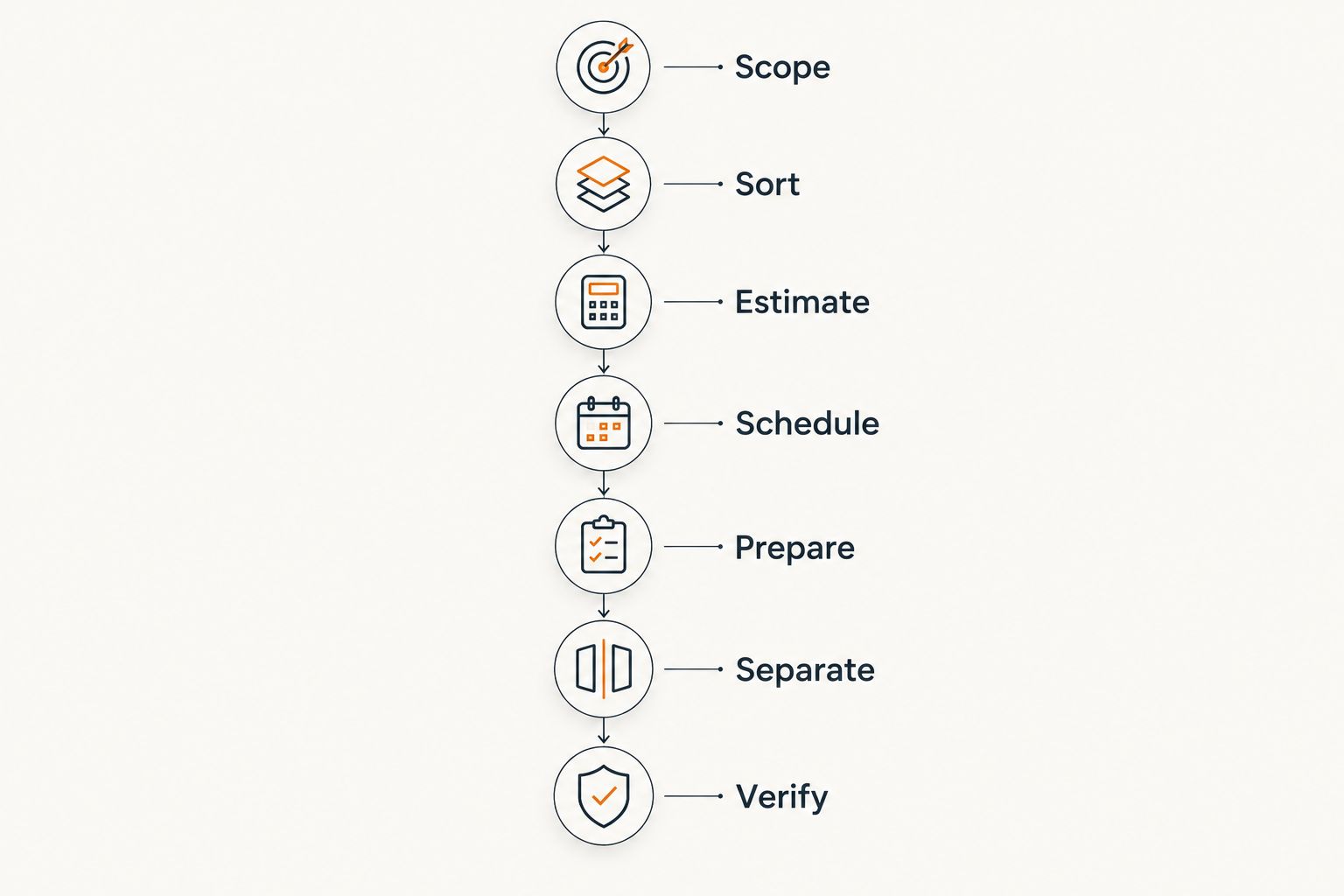
The cleanout follows a simple sequence: Scope, Sort, Estimate, Schedule, Prepare, Separate, and Verify. Settle the decisions before hauling begins; use the final walkthrough to confirm that the approved job is complete.
Compare your cleanout options
Choose by the work your organization can safely complete, not just by who can provide a vehicle. Volunteer labor, donation collection, and professional hauling solve different parts of a cleanout. None replaces the need for an approved item list.
| Option | Best for | Main advantage | Key limitation |
|---|---|---|---|
| Volunteer sorting and self-hauling | Small, manageable piles with suitable transport and capable helpers | Keeps item decisions close to your team | Requires loading, transport, destination checks, and volunteer coordination |
| Donation collection | Usable items accepted by a confirmed recipient | Gives approved goods another use | The recipient decides what to accept; rejected items still need a plan |
| Load-priced professional hauling | Bulky furniture, mixed approved junk, and full property cleanouts | Gives the removal work a defined scope and confirmed load price | Does not decide ownership or replace specialist hazardous-material services |
| Separately scoped demolition | Approved sheds and structural removal projects | Treats dismantling and debris removal as a distinct job | Requires authorization and preparation beyond ordinary loose-item hauling |
For a larger cleanout, combine methods deliberately: let your team make retention decisions, arrange accepted donations, and book hauling for what remains. Avoid booking several removal methods for the same items. That creates confusion over who is taking what and when.
Plan your church or nonprofit cleanout
Discuss the approved items, load pricing, access, and any separate demolition scope before work starts.
Common mistakes churches and nonprofits make
- Treating donated goods as automatically disposable. Confirm ownership and restrictions before removal. An old donation can still require an organizational decision.
- Letting several committees direct the crew. Collect approvals beforehand and use one on-site contact. Conflicting instructions can put retained items in the removal pile.
- Booking around volunteers but not building use. Check services, classes, tenants, and public programs together. An available volunteer does not mean the loading route is available.
- Mixing confidential records with ordinary junk. Use your approved retention and secure-destruction process. Keep sensitive paperwork out of open piles and project photographs.
- Adding a shed or unsafe materials to a furniture pickup. Demolition needs its own scope, and hazardous materials require separate qualified help. Extra work is not automatically covered by the original hauling agreement.
FAQ
What's the best way to arrange junk removal for a church?
Approve the removal list, assign one on-site contact, and confirm the load price before work starts. Schedule loading around services and programs, with a clear route that stays separate from public access.
Can a nonprofit use volunteers instead of a hauling company?
Volunteers are an option for manageable items when your organization has suitable transport, capable helpers, and confirmed disposal destinations. Bulky furniture and full property cleanouts require a separate assessment of the work your team can safely complete.
How does load pricing work for a nonprofit cleanout?
Load pricing ties the hauling quote to the approved load and work scope. Idaho Junk Solutions confirms pricing before work starts; provide photographs and a complete item list so the discussion covers the whole cleanout.
Do we need to sort donated items before junk removal?
Yes, decide which donated items stay, go to a confirmed recipient, or receive removal approval before hauling begins. Check ownership and any restrictions rather than assuming unused donations can be discarded.
Can junk removal include an old church shed?
Shed removal belongs in a separately agreed demolition scope, not an assumed furniture pickup. Confirm authorization, preparation, and debris removal before approving the work.
Can hazardous materials go in the junk removal load?
No, hazardous materials are outside Idaho Junk Solutions' pickup, handling, removal, and disposal services. Stop sorting suspected hazardous items and arrange assessment through an appropriate qualified provider.
Does a one-hour arrival window mean the cleanout takes one hour?
No, an arrival window tells you when to expect the crew, not how long the cleanout takes. Discuss the job scope separately and have your access contact ready for arrival and ETA updates.
One last thing
Clear the decision backlog before you clear the room. The hardest item is often not the heaviest one; it is the cabinet, donation, or box nobody has authority to release. Put an approval sheet beside the removal list, settle those questions beforehand, and give the on-site contact a job they can actually authorize.