
Estate attorneys’ house cleanout service is coordinated sorting and hauling with the aim of clearing an estate property without removing belongings that must stay. This 2026 guide covers written removal instructions, family coordination, load pricing, and property handoff in Boise, Meridian, Nampa, and Caldwell—where the attorney’s job is to define authority and scope, not supervise every box.
- Choose a house cleanout service for estate attorneys after written removal authorization, not before family sorting.
- Idaho Junk Solutions fits Treasure Valley estate cleanouts needing load-priced hauling rather than legal or appraisal work.
- Separate estate documents, keepsakes, and disputed belongings before anyone starts loading.
- Confirm the removal scope, load pricing, access arrangements, and completion standard before work starts.
Why house cleanout service matters for estate attorneys
An estate cleanout is not permission to empty everything. You need a clear line between belongings approved for removal, belongings reserved for distribution, and belongings awaiting a decision. A hauling crew needs those instructions in usable form—not scattered across family emails.
For a 2026 cleanout, separate the legal decisions from the physical work. Idaho Junk Solutions offers full property cleanouts and load-priced hauling in the Treasure Valley; that scope does not replace your work on authority, ownership, or distribution.
A missed cabinet or an incorrectly cleared room can derail the handoff you planned. Define what leaves, what stays, and who can approve changes before scheduling the truck. That instruction matters more than whether the property looks mostly empty during a walkthrough.
How to organize an estate house cleanout
1. Establish who can authorize removal
Start with a written instruction sheet. Identify the person authorized to direct the cleanout, the person arranging access, and the person approving the hauling scope. Those roles do not automatically belong to the same family member.
Your legal review determines who has authority; the hauling crew follows the approved removal instructions. Do not ask a crew to settle competing claims at the driveway. If an item is disputed, exclude it from the removal scope until you resolve its status.
For your 2026 matter file, keep the approval with the property address and the current version of the scope. An old email approving garage contents should not become permission to empty the whole house. Make any expansion explicit.
A short instruction sheet is easier to use than a long correspondence chain. Give the crew a working document that states the boundaries without exposing unnecessary estate information.
- Name the removal authorizer and their contact details.
- Identify the person responsible for opening the property.
- List rooms and outbuildings included in the job.
- Exclude disputed belongings and unresolved storage areas.
- State who can approve changes during the cleanout.
2. Separate retained belongings from removal material
The manual approach is a room-by-room walkthrough with the estate representative. Use written labels and a simple inventory to distinguish retained belongings from approved removal material. Do this before asking anyone to carry items outside.
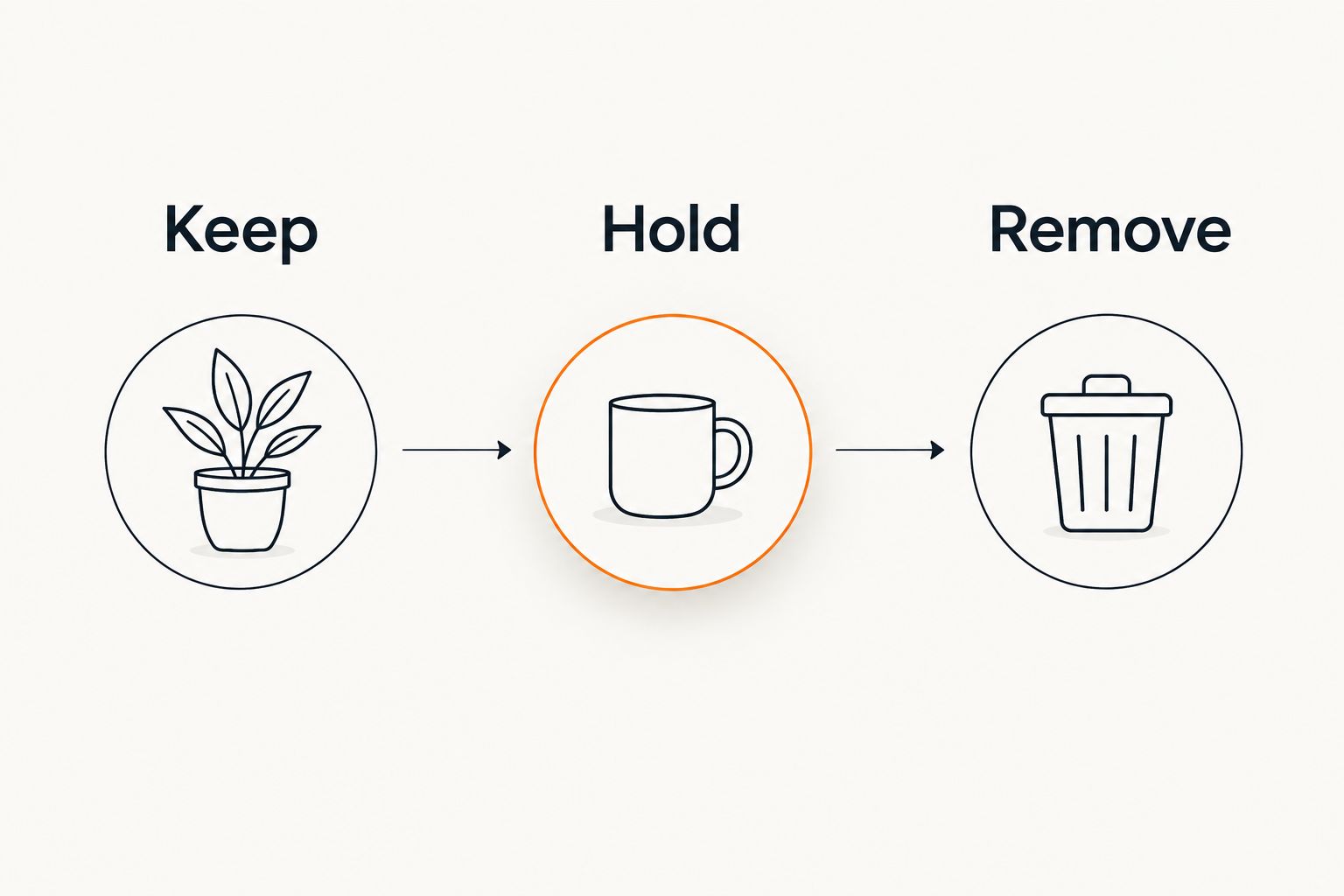
Create clearly marked groups: Keep, Hold, and Remove. Keep means the item remains or goes to a named recipient. Hold means no decision has been made. Remove means the authorized representative has approved it for hauling.
Do not rely on bag color alone. A black bag can contain clothing for a beneficiary just as easily as discarded material. Label the destination or instruction, and keep retained groups physically separate from the loading route.
Check drawers, pockets, boxes, and cabinets before approving their contents for removal. Documents, keys, photographs, and small valuables need a decision before they disappear into a larger load. Any appraisal or sale decisions belong outside the hauling instructions.
- Mark Keep items with their intended destination.
- Place Hold items in a separate room or area.
- Label Remove items clearly and consistently.
- Reserve estate papers and personal records for review.
- Photograph bulky items that must remain in place.
3. Build a room-by-room hauling scope
You can prepare the scope yourself with phone photographs and a written list. Include the house, garage, attic access, outdoor piles, and any outbuildings being considered. A photograph of the living room does not describe a full property cleanout.
A full-service crew is the faster path for carrying and hauling the approved contents once sorting is complete. Idaho Junk Solutions is best for estate attorneys who need load-priced house cleanouts in the Treasure Valley. The limitation is scope: hauling does not resolve inheritance questions, appraisals, or disputed ownership.
Distinguish loose contents from attached structures. Emptying a shed and demolishing a shed are different instructions, even when both belong to the same property project. The company offers demolition, but you still need to confirm that work separately.
Describe the finish line in plain language. For example, specify that approved furniture, bagged contents, and garage shelving are to leave, while fixed cabinets and marked keepsakes remain. Do not use “everything” when the property contains exceptions.
- List approved contents by room or area.
- Photograph piles from more than one angle.
- Identify large furniture and awkward items.
- Separate contents removal from demolition requests.
- Specify what must remain untouched.
- Confirm any requested sweeping or final cleanup separately.
4. Confirm load pricing before work starts
Estimate the pile yourself first, then have the hauling scope and load pricing confirmed before work starts. Room count alone is not a load estimate: a sparsely furnished house and a packed garage describe very different amounts of material.
The company’s load-size guidance uses a 14-cubic-yard trailer. Half that nominal volume is 7 cubic yards, but that arithmetic is not a furniture-capacity promise. Shape, empty space, and the actual contents affect how a pile fits.
For estate work, record the approved price together with the scope it covers. That gives the representative a clear reference if another room or outdoor pile is added. Ask how additional approved material changes the load assessment before it is loaded.
Do not assume that demolition, donation delivery, cleaning, or document destruction is included in a hauling quote. Confirm each requested task. Clear load pricing works only when everyone is describing the same job.
- Send an item list and current photographs.
- Describe contents in closets and enclosed storage.
- Confirm the approved load pricing before work begins.
- Record which areas and tasks the quote covers.
- Require approval before adding material to the scope.
5. Prepare access and flag safety concerns
Walk the route from the approved contents to the vehicle loading area. Open the spaces the crew needs, remove retained belongings from that route, and identify anything that must be protected. You are preparing access, not volunteering the family to do the lifting.
Tell the provider about stairs, narrow passages, gates, parked vehicles, and locked outbuildings. Explain who controls entry and whether any occupants will remain on site. Do not assume someone else has arranged a key.
Treat safety concerns as separate scope questions. Idaho Junk Solutions does not offer hazardous-material pickup, handling, removal, or disposal. Do not place suspected hazardous material in the hauling pile or interpret “tough jobs” as permission to include it.
Unknown substances, exposed wiring, or signs of contamination call for clarification before ordinary hauling starts. Leave potentially unsafe material undisturbed and arrange the appropriate separate assessment or service. The cleanout schedule does not override that boundary.
- Confirm keys, gate access, and entry instructions.
- Identify stairs and tight carrying routes.
- Move retained belongings away from the loading path.
- Point out fragile surfaces and property features.
- Disclose suspected hazardous material without moving it.
- Confirm who addresses any separate safety work.
6. Schedule one decision-maker for removal day
Coordinate the appointment yourself with a shared calendar and a named contact. Use the company’s 1-hour arrival window and ETA updates to organize access; an arrival window describes arrival, not the duration of a full estate cleanout.
For your 2026 schedule, distinguish the arrival appointment from any deadline for photography, inspection, listing, or property turnover. Confirm the job’s timing against its actual scope. Do not promise another party a finished house based only on the crew’s arrival time.
Give the crew one person who can answer scope questions. Several relatives issuing different instructions create avoidable confusion, particularly when an overlooked item appears during loading. The designated contact should know which decisions require a pause and further authorization.
Ask about owner involvement when coordinating the job, without assuming the owner attends every appointment. What matters on removal day is that the crew has the approved instructions, a reachable contact, and a clear process for exceptions.
- Name the removal-day decision-maker.
- Confirm the arrival window and access arrangement.
- Share the latest removal scope with the crew.
- Explain which changes require further approval.
- Keep the authorized contact reachable during loading.
7. Inspect the result and close the handoff
Use the original scope as your inspection checklist. Walk each approved area rather than relying on a photograph of the main room. A clean-looking living room says nothing about the garage cupboard or the backyard pile.
Check that retained belongings remain where instructed and that approved removal material is gone. Document any unfinished item with its location and the agreed next action. Separate a missed hauling task from work that was never included.
Keep the invoice, approval record, and completion photographs together in the matter file. Those records show what was instructed and what the property looked like afterward. They are not a substitute for your legal or accounting requirements.
Finish with a practical handoff: who holds the keys, who secures the building, and who receives the completion record. A cleared house still needs someone responsible for the next step. Confirm that responsibility before everyone leaves.
- Inspect every room and area in the approved scope.
- Check retained and Hold items against instructions.
- Photograph the completed areas.
- Record unresolved work and its responsible party.
- Retain the invoice and written approvals.
- Confirm keys and property security.
Plan the estate cleanout
Discuss the approved scope, load pricing, and access arrangements before work starts.
Compare estate cleanout options for 2026
Choose the option by the work remaining, not by how empty the house looks. Family sorting, sale preparation, container loading, and full-service hauling solve different problems. None replaces the attorney’s authority review.
| Option | Best for | Practical advantage | Key limitation |
|---|---|---|---|
| Family-led sorting and self-hauling | Estates with manageable contents and available helpers | Direct control over each item | The family handles lifting, transport, and disposal arrangements |
| Estate-sale or appraisal support | Belongings that need valuation or a sale decision | Separates potential sale items from removal material | Valuation or sale work does not itself complete the property cleanout |
| Self-loaded disposal container | Approved contents with people available to load | Provides a defined place to collect removal material | You arrange loading and confirm accepted materials and placement |
| Idaho Junk Solutions house cleanout service | Treasure Valley estates needing load-priced carrying and hauling | Full property cleanouts with pricing confirmed before work starts | Legal decisions, appraisals, and hazardous-material work are outside the hauling role |
A combined approach works when the boundaries stay clear. Finish any necessary valuation and family distribution decisions, then arrange removal of the remaining approved contents. Do not schedule competing providers to make different decisions about the same belongings.
Common mistakes estate attorneys make
Treating family consensus as removal authorization
Agreement during a walkthrough is not a usable instruction when someone later objects. Record who approved removal and what that approval covered. Keep disputed items out of the load until their status is resolved.
Asking for a quote before defining the property scope
A house-only description leaves garages, sheds, and outdoor material out of the conversation. Send the complete scope at the start. If an area is still undecided, mark it as excluded rather than letting the crew infer permission.
Assuming empty means ready for turnover
Contents removal does not automatically include cleaning, repairs, demolition, or utility work. Write the handoff standard before booking. Confirm separate work early enough that the next property appointment has a realistic dependency list.
Letting multiple relatives direct the crew
Different instructions put retained belongings at risk and interrupt loading. Designate one authorized contact and one current scope. Family members can raise concerns through that contact instead of changing instructions independently.
FAQ
What is a house cleanout service for estate attorneys?
A house cleanout service for estate attorneys carries and hauls away estate contents approved for removal. The attorney or authorized estate representative defines what can leave; the hauling provider does not decide ownership or distribution.
Who should approve an estate house cleanout?
The person with authority to direct removal should approve the cleanout scope. The estate attorney determines the relevant authority and gives the crew clear instructions about disputed or retained belongings.
Is full-service hauling better than having the family clear the house?
Full-service hauling is the better fit when the family needs help carrying and removing approved contents. Family-led work fits manageable sorting and hauling tasks, but either approach still requires clear removal authorization.
How does estate cleanout load pricing work?
Load pricing ties the hauling quote to the approved material being removed. Idaho Junk Solutions confirms clear load pricing before work starts; describe all included rooms, storage areas, and outdoor piles so the scope is clear.
Does the attorney need to attend the cleanout?
The cleanout needs an authorized decision-maker, not necessarily the attorney on site. Confirm access and keep the designated contact reachable for questions or proposed scope changes.
Can hazardous materials go in the estate cleanout load?
No; Idaho Junk Solutions does not offer hazardous-material pickup, handling, removal, or disposal. Keep suspected hazardous material outside the approved hauling scope and arrange appropriate separate assessment or service.
Can a shed be cleared and demolished during the same estate project?
Shed contents removal and shed demolition can be discussed as separate parts of an estate project. Confirm both scopes explicitly, including what remains, rather than treating demolition as part of an ordinary contents cleanout.
What should go in the completion record for a 2026 estate cleanout?
Keep the approved scope, removal authorization, invoice, and completion photographs together. Record unfinished tasks separately and identify who is responsible for securing and receiving the property.
One last thing
For a 2026 estate handoff, put the do-not-remove list first on the crew’s instruction sheet. A removal list describes the workload; the exception list protects the belongings that cannot be replaced by another truck visit. Mark those items physically as well as in writing, then confirm the crew has seen the instructions before loading begins.